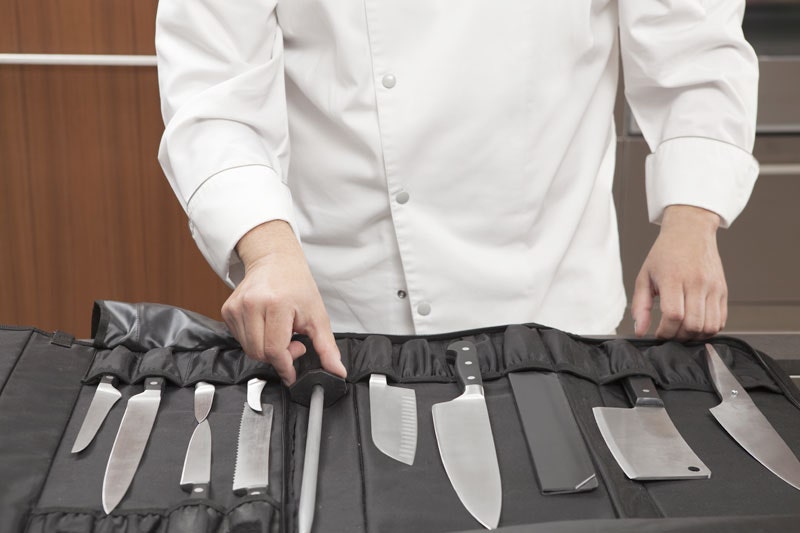
The professional Cut and Go cheese case allows you to have in a neoprene bag the knives necessary for the processing of soft, semi-hard or mature cheeses.
The bag in sturdy black neoprene fabric with a green zipper, complete with two side pockets, with shoulder strap for carrying, contains inside:
n. 1 High knife with square tip cm. 25 (blade height 5.6 cm) from the Supra line by Sanelli Ambrogio
n. 1 Knife with thin blade for Brie cm. 15 Dick's Prodynamic line
n. 1 Stepped cheese knife cm. 17 Supra line by Sanelli Ambrogio
n. 1 Knife for slicing the cheese flush with a fork
n. 1 Serrated knife with perforated blade for soft cheese cm. 15 from Dick's Prodynamic line
n. 1 Knife with square tip type Premana cm. 16
n. 1 Knife with drop-shaped blade cm. 10
n. 1 Hook knife
n. 1 Wire for cutting cheese with handle
Case size 53 x 27 cm.
FAQs
What is the ideal length for a chef's knife?
The most common length for a chef's knife is 20 cm (8 inches), which is perfect for most kitchen tasks.
However, the ideal choice depends on several factors:
Hand size: Smaller hands handle 16–18 cm blades more comfortably, while larger hands may prefer a 21–25 cm blade.
Personal habits: Those who favor broad movements and long cuts might lean toward longer knives; those who prioritize precision or work in tight spaces might prefer a shorter blade.
Experience level: Beginners tend to choose shorter, more manageable blades, while professionals often prefer 21 or 24 cm knives for greater efficiency.
In short, there is no “perfect” size for everyone — the right length should be chosen based on comfort, control, and intended use.
What’s the best way to store kitchen knives?
Avoid keeping them loose in drawers, where they can get damaged or become a safety hazard. It’s better to use a wooden block, magnetic strip, or blade guard. You can find the right solution in our catalog.
Do you have professional chef knives?
Yes, in our ecommerce store you will find only professional and high-quality chef knives.
Each model is selected to meet the needs of chefs, cooks, and cooking enthusiasts who seek reliable, sharp, and durable tools.
We offer a complete range of professional kitchen knives, ideal for precision cutting, meat, fish, vegetables, and much more.
You will find slicing knives, santoku, paring knives, and other models commonly used in professional kitchens.
We collaborate only with brands recognized at the professional level, such as [e.g., Victorinox, Global, Kai, F. Dick, Ambrogio Sanelli, Wüsthof, etc.], to offer you the best in performance and safety in the kitchen
Can I put knives in the dishwasher?
It’s highly discouraged. High heat and aggressive detergents can damage both blade and handle. Knives can also knock against other items, dulling the edge.
What does "blade hardness" mean?
Hardness refers to how resistant the steel is, measured on the Rockwell scale (HRC). The harder the steel, the better it retains its edge—but it’s also more brittle and prone to chipping.
Who should use a knife case?
A knife case is ideal for professional chefs, culinary students, or anyone who enjoys cooking outside the home. It keeps your knives organized, protected, and always ready for use.
How do I choose the right knife block?
It depends on your kitchen space, how many knives you own, and your style. You can choose from vertical blocks, horizontal blocks, or magnetic ones. On AFcoltellerie, you’ll find a full range to compare.
How many knives do I really need in a set?
That depends on your needs. Basic sets typically include 3–5 essential knives (chef’s knife, paring knife, bread knife, carving knife). Professional sets may contain 10 or more tools, such as sharpeners, kitchen scissors, and carving forks.
Is it better to buy a full set or individual knives?
If you’re just starting out or want a complete setup in one go, a set is a practical and cost-effective choice. If you’re experienced, building your own collection piece by piece might suit you better.
Do blocks and cases include knives?
It depends on the product. Some come pre-filled with knives, while others are empty and compatible with most standard knives. Always check the product description to know what’s included.
How do you clean knife blocks and cases?
Wooden blocks should be cleaned with a dry or slightly damp cloth. Knife cases can be wiped down with a mild detergent. Avoid dishwashers or soaking in water.
Can I create a custom set if I don’t find what I’m looking for?
Yes! If the combination of knives, block, or case you’re looking for isn’t listed, feel free to contact us. We’ll help you put together a custom set tailored to your needs and cooking style.
What are the essential basic tools in the kitchen?
Essential tools include good quality knives, cutting boards, pots and pans of various sizes, ladles, spatulas, whisks, and bowls. These tools allow you to easily handle most everyday cooking tasks.
What is the best material for pots and pans?
It depends on the use: stainless steel is versatile and durable, cast iron retains heat well, aluminum is lightweight and has excellent heat conductivity, while ceramic offers a non-stick surface without chemicals.
How do I choose the best cookware set?
Consider the material (stainless steel, aluminum, copper), compatibility with your stovetop, the number of pieces included, and ease of cleaning. A good set should be versatile and long-lasting.
How can I prevent damage to pots and pans over time?
Avoid using metal utensils on non-stick coatings, do not heat pots empty, and clean them with soft sponges. When storing, protect surfaces by stacking pots with cloths or separators to prevent scratches.
How do I properly care for and clean kitchen tools?
It’s important to wash them immediately after use, avoiding harsh detergents especially on delicate materials like wood or ceramic. Some tools are dishwasher safe, while others, like knives and special pots, should be hand washed. Always follow the manufacturer’s instructions.
When should I replace a kitchen utensil?
Replace utensils when they show significant wear, such as deep scratches on non-stick surfaces, broken or deformed parts, or when the material emits unusual odors or substances.
What should I do if I’m looking for a specific tool but can’t find it?
Contact us! We can help you find the right utensil or suggest suitable alternatives for your needs.
What does a complete knife case include?
A set of knives already arranged in their case, often with accessories such as a honing steel, scissors, tongs, a peeler, spatulas or a thermometer; some also include chef's clothing. The contents vary from model to model and are listed on the product page: check the type and length of each blade before you buy.
A complete case or an empty case with individual knives?
A complete case is ready to use and coordinated, which helps if you're starting from scratch or want a uniform set. An empty case with knives chosen one by one is the better option if you already own part of your kit, want to mix brands or need very specific models.
Which case should I choose for culinary school?
Start from the equipment list provided by the school, which often specifies knife types and blade lengths, and compare it with the case contents. For school use, sturdy knives with non-slip, easy-to-wash handles are the best choice. A case with a few free slots lets you add the knives you'll need in later years.
Can I personalise my knives?
Yes, with laser engraving on the blade of knives bought from AFcoltellerie: a name, a short text or your business logo. It helps you recognise your knives in a kitchen brigade or at school, or makes a personal gift. Add the personalisation service to your basket and write the text in the order notes, or send it to info@afcoltellerie.com; for a logo, we need a DXF file.
How should I store and carry a complete case?
Only put knives away clean and completely dry, each in its own slot, and close the case securely before moving it. Don't leave it for long in damp or very hot places, such as a car in summer. When you get home, open it and check that no moisture is trapped inside.