WORLDWIDE SHIPPING

 IT
 FR






 IT
 FR
 Share


Enjoy Renew: Enjoy the renewal of your restaurant's equipment
€1,659.00
€1,359.84
Availability:
In stock
This set of 50 professional tools indispensable for restaurants, wine bars with kitchens or bistros will give your kitchen the pleasure of working with high quality tools.
This set allows you to improve your way of cooking and this professional equipment will become the best ally for your dishes.
The set consisting of 50 pieces includes:
n. 1 Stainless steel conical mesh strainer Diameter 12 cm.
n. 1 Stainless steel conical mesh strainer Diameter 14 cm.
n. 1 Chinoise in stainless steel Diameter 20 cm.
n. 1 High casserole 1 stainless steel handle Chef di Piazza Collection Diameter cm. 16 Height cm. 11 Capacity 220 cl.
n. 1 High casserole 1 stainless steel handle Chef di Piazza Collection Diameter cm. 20 Height cm. 13 Capacity 410 cl.
n. 1 Stainless steel lid 16 cm diameter.
n. 1 Stainless steel lid 20 cm diameter.
n. 1 High flared pan in aluminum D. 24 cm.
n. 1 High flared pan in aluminum D. 28 cm.
n. 1 High flared pan in aluminum D. 36 cm.
n. 1 aluminum lid D. 24 cm.
n. 1 aluminum lid D. 28 cm.
n. 1 aluminum lid D. 36 cm.
n. 1 High flared non-stick frying pan in aluminum D. 24 cm.
n. 1 High flared non-stick frying pan in aluminum D. 28 cm.
n. 1 High flared non-stick frying pan in aluminum D. 32 cm.
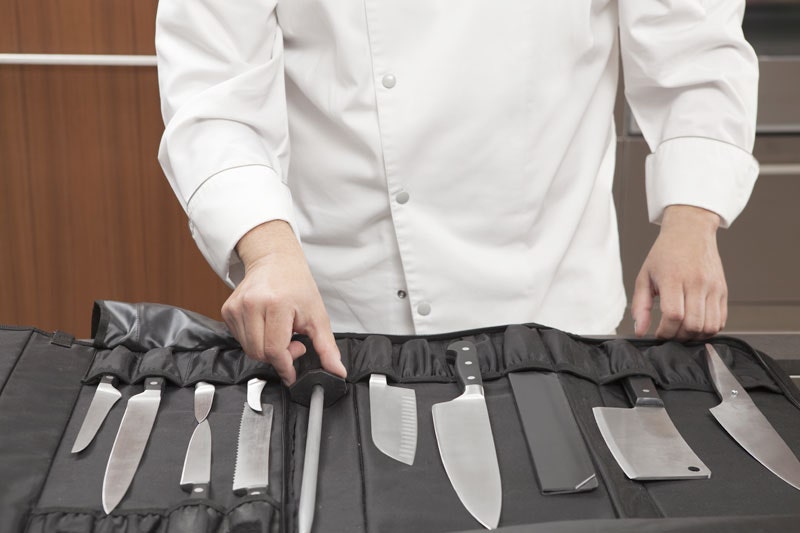
n. 1 Paring knife blade cm. 11 Atlantic Chef
n. 1 Boning blade 15 cm Atlantic Chef
n. 1 Santoku knife with alveoles cm. 19 Atlantic Chef
n. 1 Filleting knife blade cm. 18 Atlantic Chef
n. 1 Slicing knife blade cm. 23 Atlantic Chef
n. 1 Chef's knife blade cm. 23 Atlantic Chef
n. 1 Skimmer with welded mesh Diameter cm. 15 Total length cm. 54
n. 1 Scoop with one-piece holes in stainless steel 11x 14.5 Total length cm. 47
n. 1 Single piece bottom spoon stainless steel total length cm. 40
n. 1 stainless steel one-piece ladle D.10 Total length 43 cm. 25 cl.
n. 1 One-piece skimmer in stainless steel D. 12 Total length cm. 48
n. 1 Stainless steel fork with 2 points Total length 42 cm.
n. 1 Stainless steel potato peeler
n. 1 Pliers levalische and plate total length cm. 18
n. 1 Precision elbow pliers total length cm. 23.5
n. 1 White polyethylene cutting board 50 x 30 x 2 cm. with stops
n. 1 Set of 6 stainless steel nozzles with round hole
n. 1 Set of 6 stainless steel nozzles with star hole
n. 1 Set of 3 nylon bags Superflex lengths 34-46-50 cm.
n. 1 Stainless steel spatula handle in injection-molded blue plastic Length cm. 10
n. 1 Flexible stainless steel scraper with blue handle length cm. 15
n. 1 Flexible stainless steel scraper length cm. 12
n. 1 Box of 14 scalloped cutters
n. 1 Box of 14 smooth pasta cutters
n. 1 Graduated jug in plastic 1 liter
n. 1 Multipurpose kitchen scissors in stainless steel
n. 1 Professional 8-wire stainless steel whisk length cm. 30
n. 1 8-wire stainless steel whisk professional length cm. 35
n. 1 Fine-cut grater plastic handle
n. 1 Medium cut grater plastic handle
n. 1 Professional plastic spatula length cm. 35
n. 1 Professional plastic spatula length cm. 45
n. 1 Black nylon spoon length cm. 30
n. 1 Black nylon spoon length cm. 38
Italian manufacturer Piazza
Shipping times: 15 working days
FAQs