Kit to make fresh egg pasta at home with professional tools managed by the Bolognese sfogline.
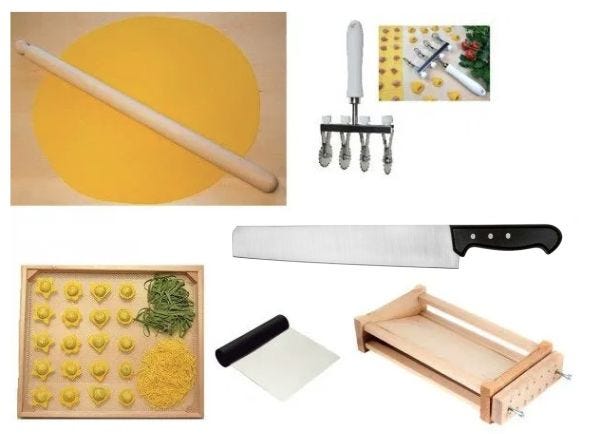
In the kit you will find:
n. 1 Rolling pin in beech with total length cm. 80 diameter 4 cm. Weight 650 grams
n. 1 adjustable pasta cutter with 4 corrugated stainless steel plates to make tortellini, tortelloni. Adjustment of cuts from mm. 24 to 120 mm. Dimensions 270 x 160 x 40 mm.
Plastic handle
n. 1 Knife for pasta and noodles cutting blade length cm. 25 POM handle suitable for dishwasher. Rivets in stainless steel. X50CrMOV15 satin stainless steel blade. Excellent sharpening for a long cutting life.
n. 1 Scraper - flexible cutter straight blade cm. 11 Height cm. 8.4 Straight base
n. 1 Small guitar cutter Small and functional guitar cutter made of beech wood and steel wires.
Supplied in 2 sizes: Spaghetti: 3 mm. and Tagliatelle: 6 mm
Dimension: cm. 20x38
n. 1 Dry Pasta: Pasta dryer tray with food net. Practical natural beech tray with fixed feet and net for food use (90/128 / EEC) with fine mesh for drying pasta. Dimensions 40x50 cm.
FAQs
What are the essential basic tools in the kitchen?
Essential tools include good quality knives, cutting boards, pots and pans of various sizes, ladles, spatulas, whisks, and bowls. These tools allow you to easily handle most everyday cooking tasks.
What is the best material for pots and pans?
It depends on the use: stainless steel is versatile and durable, cast iron retains heat well, aluminum is lightweight and has excellent heat conductivity, while ceramic offers a non-stick surface without chemicals.
How do I choose the best cookware set?
Consider the material (stainless steel, aluminum, copper), compatibility with your stovetop, the number of pieces included, and ease of cleaning. A good set should be versatile and long-lasting.
How can I prevent damage to pots and pans over time?
Avoid using metal utensils on non-stick coatings, do not heat pots empty, and clean them with soft sponges. When storing, protect surfaces by stacking pots with cloths or separators to prevent scratches.
How do I properly care for and clean kitchen tools?
It’s important to wash them immediately after use, avoiding harsh detergents especially on delicate materials like wood or ceramic. Some tools are dishwasher safe, while others, like knives and special pots, should be hand washed. Always follow the manufacturer’s instructions.
When should I replace a kitchen utensil?
Replace utensils when they show significant wear, such as deep scratches on non-stick surfaces, broken or deformed parts, or when the material emits unusual odors or substances.
What should I do if I’m looking for a specific tool but can’t find it?
Contact us! We can help you find the right utensil or suggest suitable alternatives for your needs.