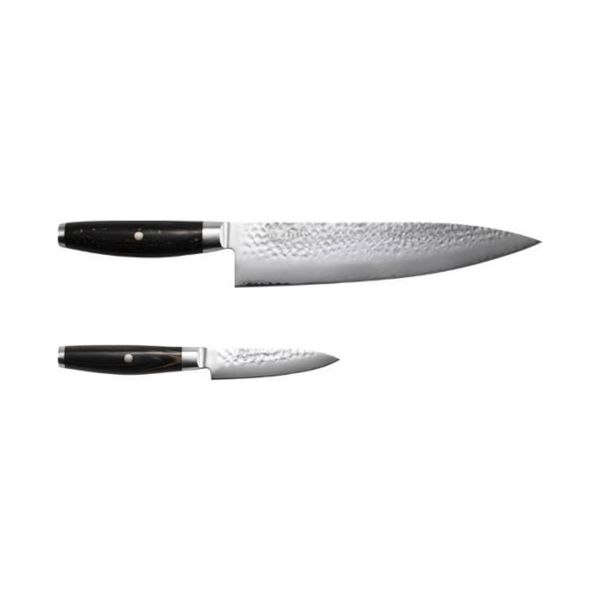
Two knives from the Yaxell Ketu Series that together cover most cutting jobs in the kitchen: the 24 cm chef's knife for chopping, slicing and mincing meat, fish and vegetables, and the 10 cm utility knife for precision work on small vegetables, meat and fish.
Ketu blades are made of 3-layer stainless steel with a core of SG2 powder steel hardened to 63 HRC, for a keen, long-lasting edge. The surface has a hammered finish. The black Pakka beech wood handle carries the samurai family crest, with the Yaxell kanji logo on the end cap.
The set includes:
- 1 chef's knife: 24 cm blade, 36 cm overall length.
- 1 utility knife: 10 cm blade, 21 cm overall length.
Features:
- 3-layer blade with SG2 steel core.
- Hardness 63 HRC.
- Hammered finish.
- Black Pakka beech wood handle.
- Made in Seki, Japan.
Wash by hand and dry immediately after use.
Delivery time: 3-4 days
FAQs
What is the ideal length for a chef's knife?
The most common length for a chef's knife is 20 cm (8 inches), which is perfect for most kitchen tasks.
However, the ideal choice depends on several factors:
Hand size: Smaller hands handle 16–18 cm blades more comfortably, while larger hands may prefer a 21–25 cm blade.
Personal habits: Those who favor broad movements and long cuts might lean toward longer knives; those who prioritize precision or work in tight spaces might prefer a shorter blade.
Experience level: Beginners tend to choose shorter, more manageable blades, while professionals often prefer 21 or 24 cm knives for greater efficiency.
In short, there is no “perfect” size for everyone — the right length should be chosen based on comfort, control, and intended use.
What’s the best way to store kitchen knives?
Avoid keeping them loose in drawers, where they can get damaged or become a safety hazard. It’s better to use a wooden block, magnetic strip, or blade guard. You can find the right solution in our catalog.
Do you have professional chef knives?
Yes, in our ecommerce store you will find only professional and high-quality chef knives.
Each model is selected to meet the needs of chefs, cooks, and cooking enthusiasts who seek reliable, sharp, and durable tools.
We offer a complete range of professional kitchen knives, ideal for precision cutting, meat, fish, vegetables, and much more.
You will find slicing knives, santoku, paring knives, and other models commonly used in professional kitchens.
We collaborate only with brands recognized at the professional level, such as [e.g., Victorinox, Global, Kai, F. Dick, Ambrogio Sanelli, Wüsthof, etc.], to offer you the best in performance and safety in the kitchen
Can I put knives in the dishwasher?
It’s highly discouraged. High heat and aggressive detergents can damage both blade and handle. Knives can also knock against other items, dulling the edge.
What does "blade hardness" mean?
Hardness refers to how resistant the steel is, measured on the Rockwell scale (HRC). The harder the steel, the better it retains its edge—but it’s also more brittle and prone to chipping.
What materials are used for knife blades?
Blades can be made of stainless steel (rust-resistant), carbon steel (very sharp but delicate), or ceramic (lightweight and razor-sharp but fragile). Premium knives often use Damascus steel or advanced alloys. Not sure which to choose? Contact us—AFcoltellerie has them all.
What are knife handles made of?
Handles can be made of wood (classic but delicate), plastic (durable and hygienic), or technical materials like micarta or G-10, which are extremely tough and non-slip even when wet.
What’s the best knife for beginners?
A 20 cm chef’s knife is the most versatile option to start with. Paired with a paring knife, it covers most everyday kitchen needs.
What are the grooves (granton edge) on a blade for?
The grooves or “granton edge” reduce friction and prevent food from sticking to the blade. They’re especially useful with wet or soft foods like fish, cheese, or vegetables.
Are there knives for left-handed users?
Yes. Some single-bevel Japanese knives are made specifically for right- or left-handed use. Many universal knives, with a double bevel, work well for both.
European or Japanese knives: what’s the difference?
European knives are sturdier, with thick, curved blades for rocking cuts and tough ingredients. Japanese knives have thinner, harder blades for clean, precise slicing—but they’re also more fragile. In short: Europeans are durable and versatile, Japanese are sharp and surgical.
What characterises the KETU series?
The KETU series by Yaxell features SG2 powdered steel combined with a design focused on ergonomics and control.Compared to more extreme lines, it maintains high performance in terms of hardness and edge retention, but with a more progressive and manageable cutting feel. The result is a precise, stable blade that feels less aggressive and more controlled during extended use.
A set or individual knives: which makes more sense?
A set makes sense when it contains knives you will actually use. The advantage is having blades from the same series, with the same steel, the same handle and the same care routine. If you need one or two specific models, it's better to buy them individually and build up your collection over time: a knife that stays in the drawer isn't a saving.
Who is it recommended for?
It is ideal for advanced users and professionals seeking high performance without sacrificing control. A great choice for those entering the SG2 category with a more balanced blade.
Which knives do I need to start with?
Three knives cover most of the work: a chef's knife of about 20 cm, or a santoku, for slicing and chopping; a paring knife for precision work; and a serrated knife for bread and foods with a hard crust or skin. From there you add specific blades, such as boning, filleting or slicing knives, depending on what you prepare most often.
What is it ideal for?
It performs best in precision work, continuous preparation, and environments where control, consistency, and clean cuts are essential.
What are specialist sets?
They are sets built around a trade or a task: butchery, fishmongery, pastry, sushi, vegetables. They bring together the blades that job requires, sometimes with dedicated accessories such as a honing steel, fish bone tweezers or a sharpening stone. They are designed for people already working in a specific field or training in that specialisation.
How should it be maintained?
It requires proper care typical of SG2 steel: hand washing, immediate drying, and regular sharpening on whetstones. Due to its higher hardness, careful use is recommended to avoid twisting or impact.
What are HACCP sets with coloured handles for?
In professional kitchens, colours help keep tools separate by type of food and reduce the risk of cross-contamination: for example red for meat, blue for fish, green for vegetables and yellow for poultry. The rules require cross-contamination to be prevented, but they don't set a single colour code: the colours should be defined in your business's food safety plan and used consistently, together with chopping boards in matching colours.
Western or Japanese set?
Western knives generally have thicker blades and softer steels: they cope better with heavy use and small knocks, and they are easy to maintain with a honing steel. Japanese knives often have thinner blades and harder steels that hold their edge for a long time and cut very precisely, but they should be used without twisting and kept away from bones. The choice depends on what you cut and how much time you want to spend on maintenance.
How do I look after the knives in a set?
Wash them by hand and dry them straight away: even when a model is declared dishwasher-safe, hand washing is better for the edge and the handle. Cut on wooden or synthetic boards, never on glass, stone or steel. Store them in a block, on a magnetic rack or in a knife case, so the blades don't knock against other utensils.
What truly distinguishes Yaxell knives within the Japanese knife market?
Yaxell occupies a very specific position: it is one of the brands that most effectively translates Japanese knife-making tradition into a high-quality industrial product, while maintaining both consistency and accessibility. Unlike fully handcrafted knives, Yaxell relies on controlled processes and modern steels such as VG-10 and SG2 to achieve high and consistent performance. The result is a blade that combines Damascus-style aesthetics, high hardness, and stable cutting performance, without entering the extreme complexity of more elite artisanal knives.
What is the real philosophy behind the Yaxell brand?
Yaxell’s philosophy is not just about Japanese tradition, but about making that tradition practical and usable at scale. Each knife is designed to deliver precise cutting, long-lasting edge stability, and strong perceived quality, including visual appeal, while maintaining consistency and reliability through industrial production.
How should the differences between Yaxell series be understood?
The main differences lie in the type of steel (VG-10 vs SG2), blade rigidity, and edge retention. VG-10 lines offer a balance between performance and ease of use, while SG2 lines represent a clear step up in performance, with higher hardness, longer edge life, and greater cutting precision.
Who are Yaxell knives recommended for?
Yaxell covers a wide range of users, from those entering the world of Japanese knives to advanced professionals. It is an ideal choice for anyone looking for high performance that remains manageable in everyday use.
What are they ideal for?
They excel in precision cutting, repetitive preparation tasks, and continuous use. The more advanced series offer greater stability and consistency during extended work sessions.
What is the correct maintenance approach?
Hand wash, dry immediately, and sharpen regularly using whetstones. SG2 series require more attention due to their higher hardness.
What distinguishes Japanese knives from Western ones?
Thinner geometries, sharper edge angles and an approach focused on precision and clean cutting.
Santoku or Gyuto: which should you choose?
The santoku is compact and versatile for everyday use; the gyuto is closer to a classic chef’s knife and is ideal for long cuts and sustained work.
Are Japanese knives more delicate?
Yes, they often require more care: they are not suitable for bones, frozen foods or twisting, but offer superior cutting performance when used correctly.