Elegant 28-piece Laguiole cutlery set with olive wood handles, handcrafted in France. Ideal for refined table settings and high-end professional service.
This 28-piece Laguiole cutlery set represents an excellent choice for fine dining and for those who value attention to detail at the table. Handcrafted in France, in the heart of the Espalion (Aveyron) tradition, each piece is entirely made by a single artisan, ensuring superior quality, consistency, and impeccable finishing.
The premium olive wood handles offer a warm, natural aesthetic as well as an ergonomic and comfortable grip during service. The satin finish enhances the natural grain of the wood, making each piece unique. The iconic Laguiole bee and the shepherd’s cross engraved on the knives reflect authenticity and respect for tradition.
The set is designed for complete professional use and includes:
6 table knives with 11 cm blades
6 forks
6 tablespoons
6 dessert spoons
1 carving set
1 cheese set
The metal parts are made of 12C27MOD stainless steel, known for its strength, durability, and long-lasting performance.
Perfect for restaurants, catering services, and hospitality environments, this set enhances table presentation, improves the customer experience, and strengthens brand image. It comes in an elegant presentation box and includes a certificate of authenticity along with a lifetime warranty against manufacturing defects.
Note: not dishwasher safe, to preserve the quality of natural materials.
Shipping time: 4–5 weeks
FAQs
What is the ideal length for a chef's knife?
The most common length for a chef's knife is 20 cm (8 inches), which is perfect for most kitchen tasks.
However, the ideal choice depends on several factors:
Hand size: Smaller hands handle 16–18 cm blades more comfortably, while larger hands may prefer a 21–25 cm blade.
Personal habits: Those who favor broad movements and long cuts might lean toward longer knives; those who prioritize precision or work in tight spaces might prefer a shorter blade.
Experience level: Beginners tend to choose shorter, more manageable blades, while professionals often prefer 21 or 24 cm knives for greater efficiency.
In short, there is no “perfect” size for everyone — the right length should be chosen based on comfort, control, and intended use.
What’s the best way to store kitchen knives?
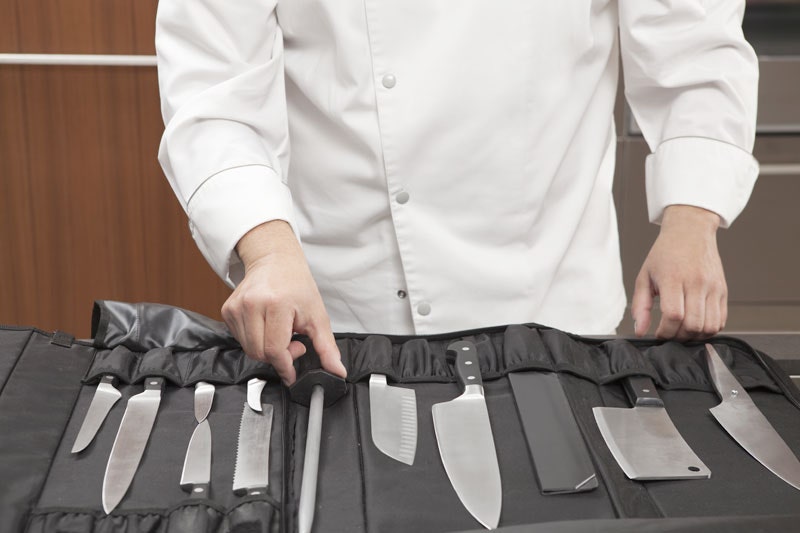
Avoid keeping them loose in drawers, where they can get damaged or become a safety hazard. It’s better to use a wooden block, magnetic strip, or blade guard. You can find the right solution in our catalog.
Do you have professional chef knives?
Yes, in our ecommerce store you will find only professional and high-quality chef knives.
Each model is selected to meet the needs of chefs, cooks, and cooking enthusiasts who seek reliable, sharp, and durable tools.
We offer a complete range of professional kitchen knives, ideal for precision cutting, meat, fish, vegetables, and much more.
You will find slicing knives, santoku, paring knives, and other models commonly used in professional kitchens.
We collaborate only with brands recognized at the professional level, such as [e.g., Victorinox, Global, Kai, F. Dick, Ambrogio Sanelli, Wüsthof, etc.], to offer you the best in performance and safety in the kitchen
Can I put knives in the dishwasher?
It’s highly discouraged. High heat and aggressive detergents can damage both blade and handle. Knives can also knock against other items, dulling the edge.
What does "blade hardness" mean?
Hardness refers to how resistant the steel is, measured on the Rockwell scale (HRC). The harder the steel, the better it retains its edge—but it’s also more brittle and prone to chipping.
What materials are used for knife blades?
Blades can be made of stainless steel (rust-resistant), carbon steel (very sharp but delicate), or ceramic (lightweight and razor-sharp but fragile). Premium knives often use Damascus steel or advanced alloys. Not sure which to choose? Contact us—AFcoltellerie has them all.
What are knife handles made of?
Handles can be made of wood (classic but delicate), plastic (durable and hygienic), or technical materials like micarta or G-10, which are extremely tough and non-slip even when wet.
What’s the best knife for beginners?
A 20 cm chef’s knife is the most versatile option to start with. Paired with a paring knife, it covers most everyday kitchen needs.
What are the grooves (granton edge) on a blade for?
The grooves or “granton edge” reduce friction and prevent food from sticking to the blade. They’re especially useful with wet or soft foods like fish, cheese, or vegetables.
Are there knives for left-handed users?
Yes. Some single-bevel Japanese knives are made specifically for right- or left-handed use. Many universal knives, with a double bevel, work well for both.
European or Japanese knives: what’s the difference?
European knives are sturdier, with thick, curved blades for rocking cuts and tough ingredients. Japanese knives have thinner, harder blades for clean, precise slicing—but they’re also more fragile. In short: Europeans are durable and versatile, Japanese are sharp and surgical.
What sets original French LAGUIOLE knives apart?
LAGUIOLE knives are distinguished by their strong connection with their place of origin and the French craft tradition. The original knives offered here are handmade by cutlers in workshops located in the village of Laguiole, where the different manufacturing stages are once again concentrated. This direct relationship with the territory is a key factor in distinguishing genuine Laguiole knives from the many imitations on the market.
Production emphasises carefully selected materials and a forged blade, contributing to the knife's character and overall quality. The aim is not simply to reproduce a famous shape, but to keep alive a manufacturing culture connected with the history of Laguiole and the expertise of its cutlers.
Choosing an original LAGUIOLE knife therefore means choosing a FABRIQUÉ EN FRANCE product, made in its place of origin according to a tradition that combines hand craftsmanship, material selection and French identity.
Where are original LAGUIOLE knives made?
The original LAGUIOLE knives offered in this category are made in France, in workshops located in the village of Laguiole. The return of production to its place of origin is central to the brand's contemporary story: all stages of knife manufacturing are once again carried out in Laguiole, restoring the direct link between product, territory and craft tradition.
This is particularly important because the Laguiole name has become widely known and is also used for products manufactured far from France. The characteristic shape or the Laguiole name alone is therefore not sufficient to identify a knife genuinely made in its historic territory.
For anyone seeking French originals, provenance is essential. The wording FABRIQUÉ EN FRANCE and production in Laguiole workshops highlight a supply chain linked to local cutlers and to the revival of knife making in its place of origin.
How are LAGUIOLE knives made?
LAGUIOLE knives highlight the manual work of cutlers and the use of carefully selected materials. One of their defining features is the forged blade, produced through a process that contributes to the technical and artisanal identity of the knife.
The value of the knife, however, comes from the complete manufacturing process. Material selection, component machining, assembly and finishing all contribute to an object in which function and aesthetics are closely connected. Manufacturing once again carried out in the village of Laguiole also keeps these operations within the territory from which the knife takes its name.
Each knife therefore expresses a project intended to revive Laguiole's traditional knife-making craft. An original LAGUIOLE should not be judged only by its appearance: French origin, craftsmanship, selected materials and a forged blade together define the offering.
How can you recognise and choose an original LAGUIOLE knife?
When choosing an original LAGUIOLE knife, appearance alone is not enough. The success of the Laguiole form has led to numerous imitations, including products made in Asia that may reproduce its style and name without sharing the same origin or manufacturing tradition.
The first point to verify is provenance. The original LAGUIOLE knives in this category are made in France and linked to workshops in the village of Laguiole, where the manufacturing stages are carried out. In this context, FABRIQUÉ EN FRANCE has a concrete meaning because it identifies the return of knife production to its historic place of origin.
Build quality should also be considered: hand craftsmanship by cutlers, carefully selected materials and a forged blade help distinguish these products. Choosing LAGUIOLE therefore means looking not for a simple imitation of the style, but for an authentic French knife connected with Laguiole's tradition and territory.