WORLDWIDE SHIPPING

 IT
 FR

- KNIVES
- JAPANESE KNIVES
- EUROPEAN KNIVES
- PROMOTIONAL AND CUSTOMIZATIONS
- CHEF'S CASES - KNIVES BLOCKS - SETS
- SHARPENING
- PASTRY
- PASTRY UTENSILS
- ACCESSORIES & UTENSILS
- CAKE STANDS AND DISPLAY
- CHOCOLATE
- MARTELLATO PROFESSIONAL
- PAVONI ITALIA
- BRUSHES, SPATULAS AND WHIPS
- SCHNEIDER
- SILICONE
- SILIKOMART PROFESSIONAL
- AIRPLUS
- CHOCADO
- ÉCLAIR
- DECORATIVE ELEMENTS
- FRUITS 3D
- ICE
- MINI DESSERTS - MIGNON
- MODERN SINGLE PORTIONS
- CLASSIC SINGLE PORTIONS AND CAKES
- NATURAE
- 60 X 40 MOLDS
- AIR MAT
- TARTE 4.0
- JELLY MOULDS
- MODERN CAKES
- STORAGE AND DISPLAY I-GLOO AND MACADO'
- MOULDS FOR CHOCOLATES
- CHOCOLATE ACCESSORIES
- SMALL PLATES
- ACCESSORIES
- CRAFT MOULDS
- PASTRY CUTTER
- TRAYS, GRADE, BOWLS, JUGS, BOTTLES
- THERMOMETERS, TIMER AND SCALES
- BAKEWARE, RINGS AND MOULDS
- MOULDS
- PACKAGING AND PASTRY TRAYS
- BAKING MATS & LINERS
- GUITARS - FRAMES
- VALENTINE'S DAY - MOTHER'S DAY
- DECORATING CAKES
- ICE-CREAM SHOP
- PASTRY UTENSILS
- KITCHEN
- WELLNESS KITCHEN
- COOKING UTENSILS
- ELECTRIC KITCHEN UTENSILS
- POTS
- CARVING & DECORATION
- MANDOLINE AND GRATERS
- ETHNIC CUISINE
- CATERING & BUFFET
- COOKING BOOKS

- CLOTHING
- TABLE & BAR
- HOME & FREE TIME
- GIFT IDEAS
- NEWS
- SALES
- SPARE PARTS
- DELUXE
- AFCOLTELLERIE Home
- Blog
- Business

 IT
 FR


Magnetic bar for knives cm. 50 in Acacia wood from Wusthof
€62.00
€50.82
Availability:
In stock
The WÜSTHOF magnetic knife bar 50 cm. made of acacia wood is a beautiful, easy and safe way to hang your favorite kitchen knives.
With clean lines, this modern magnetic knife bar will save space and never damage your knives like you might when storing them in your kitchen drawers.
This 50 cm knife bar. it is made of high quality acacia wood and includes a hidden super magnetic that ensures your knives stay in place, while the beautiful wood grain will complement any kitchen decor.
Secure the magnetic strip to the wall with the included mounting bracket and two screws (also included). You can then easily clip the wooden magnetic holder onto the mounting bracket. As a result, you won't see the bracket or screws, and the magnetic strip is firmly attached to the wall.
Dimensions 50cm x 6.3cm x 2cm
FAQs
What is the ideal length for a chef's knife?
The most common length for a chef's knife is 20 cm (8 inches), which is perfect for most kitchen tasks.
However, the ideal choice depends on several factors:
Hand size: Smaller hands handle 16–18 cm blades more comfortably, while larger hands may prefer a 21–25 cm blade.
Personal habits: Those who favor broad movements and long cuts might lean toward longer knives; those who prioritize precision or work in tight spaces might prefer a shorter blade.
Experience level: Beginners tend to choose shorter, more manageable blades, while professionals often prefer 21 or 24 cm knives for greater efficiency.
In short, there is no “perfect” size for everyone — the right length should be chosen based on comfort, control, and intended use.
What’s the best way to store kitchen knives?
Avoid keeping them loose in drawers, where they can get damaged or become a safety hazard. It’s better to use a wooden block, magnetic strip, or blade guard. You can find the right solution in our catalog.
Do you have professional chef knives?
Yes, in our ecommerce store you will find only professional and high-quality chef knives.
Each model is selected to meet the needs of chefs, cooks, and cooking enthusiasts who seek reliable, sharp, and durable tools.
We offer a complete range of professional kitchen knives, ideal for precision cutting, meat, fish, vegetables, and much more.
You will find slicing knives, santoku, paring knives, and other models commonly used in professional kitchens.
We collaborate only with brands recognized at the professional level, such as [e.g., Victorinox, Global, Kai, F. Dick, Ambrogio Sanelli, Wüsthof, etc.], to offer you the best in performance and safety in the kitchen
Can I put knives in the dishwasher?
It’s highly discouraged. High heat and aggressive detergents can damage both blade and handle. Knives can also knock against other items, dulling the edge.
What does "blade hardness" mean?
Hardness refers to how resistant the steel is, measured on the Rockwell scale (HRC). The harder the steel, the better it retains its edge—but it’s also more brittle and prone to chipping.
Who should use a knife case?
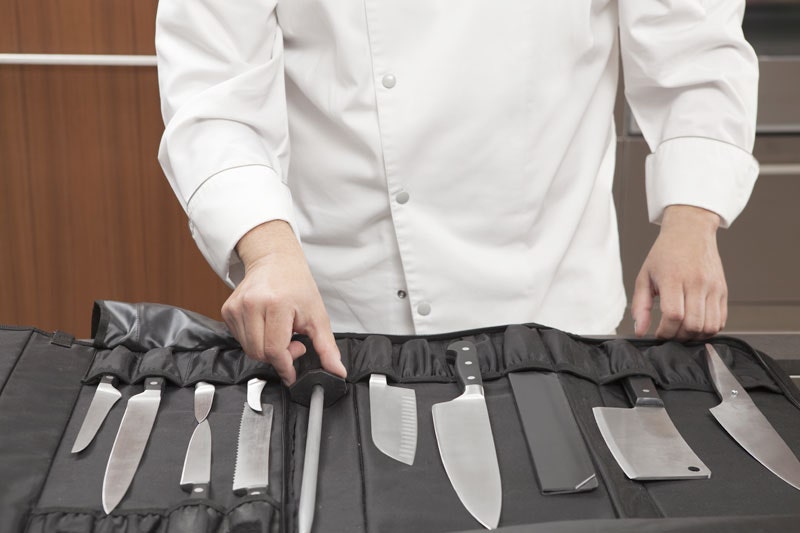
A knife case is ideal for professional chefs, culinary students, or anyone who enjoys cooking outside the home. It keeps your knives organized, protected, and always ready for use.
How do I choose the right knife block?
It depends on your kitchen space, how many knives you own, and your style. You can choose from vertical blocks, horizontal blocks, or magnetic ones. On AFcoltellerie, you’ll find a full range to compare.
How many knives do I really need in a set?
That depends on your needs. Basic sets typically include 3–5 essential knives (chef’s knife, paring knife, bread knife, carving knife). Professional sets may contain 10 or more tools, such as sharpeners, kitchen scissors, and carving forks.
Is it better to buy a full set or individual knives?
If you’re just starting out or want a complete setup in one go, a set is a practical and cost-effective choice. If you’re experienced, building your own collection piece by piece might suit you better.
Do blocks and cases include knives?
It depends on the product. Some come pre-filled with knives, while others are empty and compatible with most standard knives. Always check the product description to know what’s included.
How do you clean knife blocks and cases?
Wooden blocks should be cleaned with a dry or slightly damp cloth. Knife cases can be wiped down with a mild detergent. Avoid dishwashers or soaking in water.
Can I create a custom set if I don’t find what I’m looking for?
Yes! If the combination of knives, block, or case you’re looking for isn’t listed, feel free to contact us. We’ll help you put together a custom set tailored to your needs and cooking style.
What materials are used for knife blades?
Blades can be made of stainless steel (rust-resistant), carbon steel (very sharp but delicate), or ceramic (lightweight and razor-sharp but fragile). Premium knives often use Damascus steel or advanced alloys. Not sure which to choose? Contact us—AFcoltellerie has them all.
What are knife handles made of?
Handles can be made of wood (classic but delicate), plastic (durable and hygienic), or technical materials like micarta or G-10, which are extremely tough and non-slip even when wet.
European or Japanese knives: what’s the difference?
European knives are sturdier, with thick, curved blades for rocking cuts and tough ingredients. Japanese knives have thinner, harder blades for clean, precise slicing—but they’re also more fragile. In short: Europeans are durable and versatile, Japanese are sharp and surgical.
What’s the best knife for beginners?
A 20 cm chef’s knife is the most versatile option to start with. Paired with a paring knife, it covers most everyday kitchen needs.
What are the grooves (granton edge) on a blade for?
The grooves or “granton edge” reduce friction and prevent food from sticking to the blade. They’re especially useful with wet or soft foods like fish, cheese, or vegetables.
Are there knives for left-handed users?
Yes. Some single-bevel Japanese knives are made specifically for right- or left-handed use. Many universal knives, with a double bevel, work well for both.
Why choose a magnetic knife rack?
It frees up the worktop, keeps knives visible and within reach, and has no internal slots to clean. Each knife stays separate from the others, so the edge doesn't knock against other utensils. With no fixed slots, it takes knives of different shapes and sizes, from a paring knife to a bread knife.
A set or individual knives: which makes more sense?
A set makes sense when it contains knives you will actually use. The advantage is having blades from the same series, with the same steel, the same handle and the same care routine. If you need one or two specific models, it's better to buy them individually and build up your collection over time: a knife that stays in the drawer isn't a saving.
Wood or steel?
Stainless steel and aluminium racks are durable and easy to clean, even in a professional kitchen. Wood is softer to the touch: it is less likely to scratch the blade finish and cushions the impact as the knife attaches, and it's also an aesthetic choice to match your kitchen. Either way, the hold depends on the strength of the magnets inside, not on the outer material.
Which knives do I need to start with?
Three knives cover most of the work: a chef's knife of about 20 cm, or a santoku, for slicing and chopping; a paring knife for precision work; and a serrated knife for bread and foods with a hard crust or skin. From there you add specific blades, such as boning, filleting or slicing knives, depending on what you prepare most often.
What length should I choose?
Start from the number of knives and the wall space. There should be enough room between handles to grab one knife without touching the others, and wide blades take up more space. A short rack of 30 to 35 cm suits a basic collection; a full set generally needs 45 to 60 cm.
What are specialist sets?
They are sets built around a trade or a task: butchery, fishmongery, pastry, sushi, vegetables. They bring together the blades that job requires, sometimes with dedicated accessories such as a honing steel, fish bone tweezers or a sharpening stone. They are designed for people already working in a specific field or training in that specialisation.
Do all knives stick to a magnetic rack?
No. Ceramic and titanium blades aren't magnetic and won't stick. Most steel kitchen knives, stainless or carbon, attach without any problem. For very heavy knives, such as cleavers and large butcher's knives, check that the rack's hold is adequate before hanging them.
What are HACCP sets with coloured handles for?
In professional kitchens, colours help keep tools separate by type of food and reduce the risk of cross-contamination: for example red for meat, blue for fish, green for vegetables and yellow for poultry. The rules require cross-contamination to be prevented, but they don't set a single colour code: the colours should be defined in your business's food safety plan and used consistently, together with chopping boards in matching colours.
How do I attach and remove knives without damaging them?
Bring the knife to the rack spine first, then roll the blade flat against it: this way the edge doesn't snap against the bar. To remove it, roll the edge away from the bar and then lift the knife off. Avoid sliding the knife along the surface: it scratches the blade and wears the edge.
Western or Japanese set?
Western knives generally have thicker blades and softer steels: they cope better with heavy use and small knocks, and they are easy to maintain with a honing steel. Japanese knives often have thinner blades and harder steels that hold their edge for a long time and cut very precisely, but they should be used without twisting and kept away from bones. The choice depends on what you cut and how much time you want to spend on maintenance.
How do I install the rack safely?
Fix it to a solid wall with screws and plugs suited to the wall type, following the manufacturer's instructions. Choose a spot that's convenient while you work but away from the hob, sink splashes and walkways, and out of children's reach. Check from time to time that it is still firmly fixed.
How do I look after the knives in a set?
Wash them by hand and dry them straight away: even when a model is declared dishwasher-safe, hand washing is better for the edge and the handle. Cut on wooden or synthetic boards, never on glass, stone or steel. Store them in a block, on a magnetic rack or in a knife case, so the blades don't knock against other utensils.