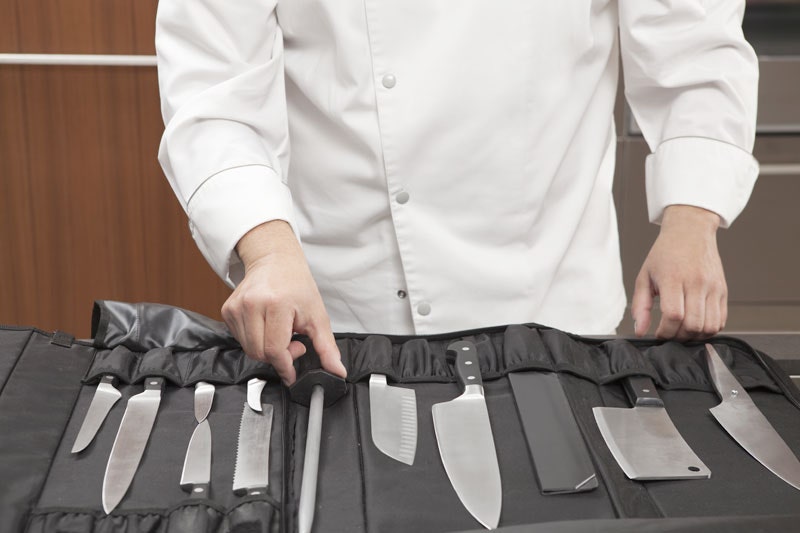
This Wusthof case set up with 3 Kasumi Tora Series knives.
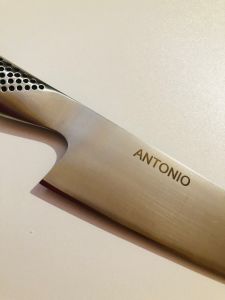
Tora knives are Japanese kitchen knives with high carbon Molybdenum Vanadium stainless steel blade.
DSR1K6 molybdenum vanadium stainless steel blades with hardness: 56-58 +/- 1 HRC
The perfectly sharp and polished cutting edge is perfected by a double finishing process and by a system of Japanese water grit # 3000 grit wheels to obtain a very sharp professional blade.
Magnolia wood handle with black epoxy coating.
KASUMI Japan professional Japanese knife, a truly exceptional product with quality materials and an excellent design, a guarantee of elegance in your kitchen.
In the Wusthof case capable of holding up to 12 knives and accessories, you will find 3 V-cut knives from Kasumi's Tora Series with the following characteristics:
n. 1 Paring knife blade length cm. 9
n. 1 Santoku knife for cutting vegetables blade length cm. 16,5
n. 1 Chef's knife for many cuts in the kitchen blade length cm. 21
Closed case dimensions: 51 x 17 cm.
FAQs
What is the ideal length for a chef's knife?
The most common length for a chef's knife is 20 cm (8 inches), which is perfect for most kitchen tasks.
However, the ideal choice depends on several factors:
Hand size: Smaller hands handle 16–18 cm blades more comfortably, while larger hands may prefer a 21–25 cm blade.
Personal habits: Those who favor broad movements and long cuts might lean toward longer knives; those who prioritize precision or work in tight spaces might prefer a shorter blade.
Experience level: Beginners tend to choose shorter, more manageable blades, while professionals often prefer 21 or 24 cm knives for greater efficiency.
In short, there is no “perfect” size for everyone — the right length should be chosen based on comfort, control, and intended use.
What’s the best way to store kitchen knives?
Avoid keeping them loose in drawers, where they can get damaged or become a safety hazard. It’s better to use a wooden block, magnetic strip, or blade guard. You can find the right solution in our catalog.
Do you have professional chef knives?
Yes, in our ecommerce store you will find only professional and high-quality chef knives.
Each model is selected to meet the needs of chefs, cooks, and cooking enthusiasts who seek reliable, sharp, and durable tools.
We offer a complete range of professional kitchen knives, ideal for precision cutting, meat, fish, vegetables, and much more.
You will find slicing knives, santoku, paring knives, and other models commonly used in professional kitchens.
We collaborate only with brands recognized at the professional level, such as [e.g., Victorinox, Global, Kai, F. Dick, Ambrogio Sanelli, Wüsthof, etc.], to offer you the best in performance and safety in the kitchen
Can I put knives in the dishwasher?
It’s highly discouraged. High heat and aggressive detergents can damage both blade and handle. Knives can also knock against other items, dulling the edge.
What does "blade hardness" mean?
Hardness refers to how resistant the steel is, measured on the Rockwell scale (HRC). The harder the steel, the better it retains its edge—but it’s also more brittle and prone to chipping.
Who should use a knife case?
A knife case is ideal for professional chefs, culinary students, or anyone who enjoys cooking outside the home. It keeps your knives organized, protected, and always ready for use.
How do I choose the right knife block?
It depends on your kitchen space, how many knives you own, and your style. You can choose from vertical blocks, horizontal blocks, or magnetic ones. On AFcoltellerie, you’ll find a full range to compare.
How many knives do I really need in a set?
That depends on your needs. Basic sets typically include 3–5 essential knives (chef’s knife, paring knife, bread knife, carving knife). Professional sets may contain 10 or more tools, such as sharpeners, kitchen scissors, and carving forks.
Is it better to buy a full set or individual knives?
If you’re just starting out or want a complete setup in one go, a set is a practical and cost-effective choice. If you’re experienced, building your own collection piece by piece might suit you better.
Do blocks and cases include knives?
It depends on the product. Some come pre-filled with knives, while others are empty and compatible with most standard knives. Always check the product description to know what’s included.
How do you clean knife blocks and cases?
Wooden blocks should be cleaned with a dry or slightly damp cloth. Knife cases can be wiped down with a mild detergent. Avoid dishwashers or soaking in water.
Can I create a custom set if I don’t find what I’m looking for?
Yes! If the combination of knives, block, or case you’re looking for isn’t listed, feel free to contact us. We’ll help you put together a custom set tailored to your needs and cooking style.
What materials are used for knife blades?
Blades can be made of stainless steel (rust-resistant), carbon steel (very sharp but delicate), or ceramic (lightweight and razor-sharp but fragile). Premium knives often use Damascus steel or advanced alloys. Not sure which to choose? Contact us—AFcoltellerie has them all.
What are knife handles made of?
Handles can be made of wood (classic but delicate), plastic (durable and hygienic), or technical materials like micarta or G-10, which are extremely tough and non-slip even when wet.
European or Japanese knives: what’s the difference?
European knives are sturdier, with thick, curved blades for rocking cuts and tough ingredients. Japanese knives have thinner, harder blades for clean, precise slicing—but they’re also more fragile. In short: Europeans are durable and versatile, Japanese are sharp and surgical.
What’s the best knife for beginners?
A 20 cm chef’s knife is the most versatile option to start with. Paired with a paring knife, it covers most everyday kitchen needs.
What are the grooves (granton edge) on a blade for?
The grooves or “granton edge” reduce friction and prevent food from sticking to the blade. They’re especially useful with wet or soft foods like fish, cheese, or vegetables.
Are there knives for left-handed users?
Yes. Some single-bevel Japanese knives are made specifically for right- or left-handed use. Many universal knives, with a double bevel, work well for both.
What truly characterises the Tora series?
The Tora series is designed as an entry point into the Kasumi world, but it is not simply a low-cost line. It is built to offer robustness, simplicity and reliability. Its geometry is less extreme, the edge profile less aggressive and the steel more forgiving, making the knife easier to use and maintain.
What characterises Kasumi complete cases?
Kasumi complete cases stand out because they are not simply transport solutions, but fully equipped sets designed for professional or advanced use. Inside, they include a selection of professional knives and premium accessories, arranged in a safe and organised way. The case therefore serves not only to protect and transport the equipment, but also as a complete solution that combines quality, function and presentation.
Who is it really recommended for?
It is ideal for users moving into Japanese knives after working with Western-style models, or for anyone who wants a dependable everyday knife without having to deal with the complexity of a harder, thinner blade. It can also work well in professional settings where the knife is used intensively but not for highly specialised tasks.
Who are they recommended for?
They are recommended for professionals, trainers, travelling chefs and anyone looking for a complete set of high-level knives and accessories. They are especially suitable for users who want a ready-to-use solution that combines operational practicality with the value of premium equipment.
What is it really suited for?
It is well suited to everyday preparation: vegetables, meat and general kitchen tasks. Its real strength lies in versatility and resilience rather than extreme precision. It performs well even in less controlled environments than more refined Kasumi series.
For which uses do they offer the greatest value?
They offer the greatest value in situations where having a complete and well-organised set always available is important, such as catering, training, consulting, cooking schools or moving between kitchens and workstations. In these contexts, the case is not just a transport accessory, but a true extension of professional equipment.
How should it be managed over time?
It requires simpler maintenance than other Kasumi lines: it can be sharpened more often with less risk, and it is more tolerant of small usage mistakes. Hand washing and suitable cutting surfaces are still recommended.
How should they be maintained and managed?
Cases should be kept clean and dry and checked regularly to ensure that compartments, protections, accessories and closures continue to function properly. A complete case truly retains its value when it is handled with care and order, helping protect both the knives and the included accessories over time.
What truly distinguishes Kasumi knives within the Japanese knife market?
Kasumi occupies a very interesting position because it strikes a balance between Japanese tradition and real-world accessibility. Its use of VG-10 steel, often combined with Damascus-style layering, allows for strong edge retention and refined cutting performance without necessarily reaching the most extreme hardness levels, which can make a knife more demanding to handle. This makes Kasumi a brand that offers aesthetics, precision and reliability, while remaining more approachable than more elite and demanding lines.
How should the differences between Kasumi series be understood?
Kasumi series differ not only in appearance, but also in their philosophy of use. The Damascus VG-10 line represents the brand’s balance of tradition and visual appeal; VG-10 Pro is geared toward more professional, continuous use; HM Hammered adds a functional benefit in food release; Titanium and Ceramic explore alternative materials; while Tora offers an easier entry point into Japanese knives. Understanding these differences is essential in order to choose based on use, rather than on looks alone.
Who is Kasumi, as a brand, really suited for?
Kasumi is particularly well suited to users who want to enter the world of Japanese knives with serious tools, but without immediately moving into the most extreme premium segment. It is ideal for advanced home cooks, enthusiastic users and also for less demanding professional environments, where a good balance of performance, durability and ease of maintenance matters.
How should someone choose the right Kasumi series in an informed way?
The choice should begin with actual use. Those who cook frequently and want strong performance may prefer VG-10 Pro or HM Hammered; those drawn to aesthetics and tradition may lean toward Damascus VG-10; users seeking greater ease of use may choose Tora; and those with specific needs may consider Ceramic or Titanium. The real question is not which line is objectively best, but which one best matches the way the knife will actually be used.