WORLDWIDE SHIPPING
Share

Case Events Emilia sausages: case containing slicing knives and accessories

was €280.00 Special Price €266.00 €218.03
Availability: In stock
The heart of Emilian gastronomy are salted meats : mortadella, salami, crude ham, culatello (special crude ham), coppa...
More and more aperitives and gastronomic events not only in this region, but in all Italy and also in the whole world include important sausages produced with great skill by Emilia's artisans.
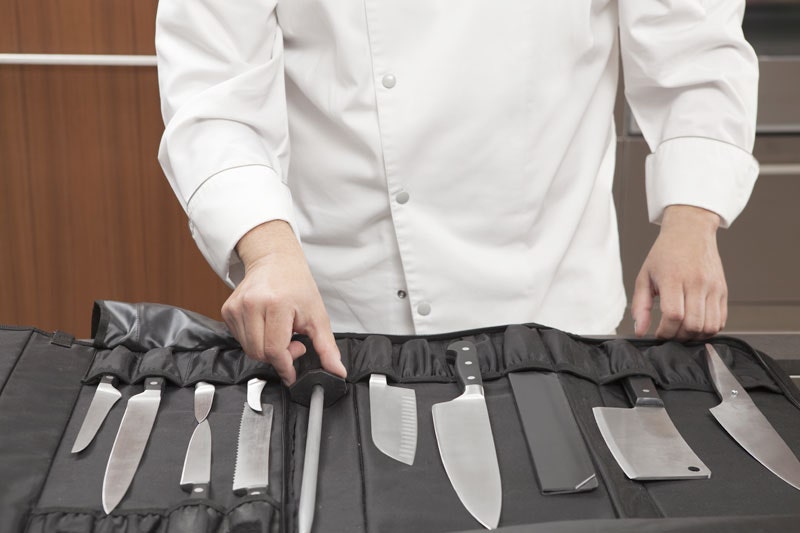
This case groups some essential instruments to cut by hand these precious salted meats .
In the large Due Cigni case you will find the following implements :
- Boning knife Dick Series Superior blade cm. 13, to clean crude ham and all other sausages.
- Flexible knife blade cm. 18 Dick Series Superior, to slice small sausages (felino, piacentino salami etc.)
- Fork to serve Dick Series Superior cm. 13 to serve all sausages after cutting
- Bread knife Dick Series Prodynamic cm. 23 L shaped toothed-edge to cut all types of bread both soft and with crust BR>- Slicing knife Dick Series Superior blade cm. 28 for crude ham, culatello etc.
- Knife for salted food Paderno blade cm. 36 to cut mortadella
- Pliers curved point to serve cm. 35
- Pliers for sliced salted meat

FAQs
What is the ideal length for a chef's knife?
The most common length for a chef's knife is 20 cm (8 inches), which is perfect for most kitchen tasks. However, the ideal choice depends on several factors: Hand size: Smaller hands handle 16–18 cm blades more comfortably, while larger hands may prefer a 21–25 cm blade. Personal habits: Those who favor broad movements and long cuts might lean toward longer knives; those who prioritize precision or work in tight spaces might prefer a shorter blade. Experience level: Beginners tend to choose shorter, more manageable blades, while professionals often prefer 21 or 24 cm knives for greater efficiency. In short, there is no “perfect” size for everyone — the right length should be chosen based on comfort, control, and intended use.
What’s the best way to store kitchen knives?

Avoid keeping them loose in drawers, where they can get damaged or become a safety hazard. It’s better to use a wooden block, magnetic strip, or blade guard. You can find the right solution in our catalog.
Do you have professional chef knives?
Yes, in our ecommerce store you will find only professional and high-quality chef knives. Each model is selected to meet the needs of chefs, cooks, and cooking enthusiasts who seek reliable, sharp, and durable tools. We offer a complete range of professional kitchen knives, ideal for precision cutting, meat, fish, vegetables, and much more. You will find slicing knives, santoku, paring knives, and other models commonly used in professional kitchens. We collaborate only with brands recognized at the professional level, such as [e.g., Victorinox, Global, Kai, F. Dick, Ambrogio Sanelli, Wüsthof, etc.], to offer you the best in performance and safety in the kitchen
Can I put knives in the dishwasher?

It’s highly discouraged. High heat and aggressive detergents can damage both blade and handle. Knives can also knock against other items, dulling the edge.
What does "blade hardness" mean?

Hardness refers to how resistant the steel is, measured on the Rockwell scale (HRC). The harder the steel, the better it retains its edge—but it’s also more brittle and prone to chipping.
Who should use a knife case?
A knife case is ideal for professional chefs, culinary students, or anyone who enjoys cooking outside the home. It keeps your knives organized, protected, and always ready for use.
How do I choose the right knife block?
It depends on your kitchen space, how many knives you own, and your style. You can choose from vertical blocks, horizontal blocks, or magnetic ones. On AFcoltellerie, you’ll find a full range to compare.
How many knives do I really need in a set?
That depends on your needs. Basic sets typically include 3–5 essential knives (chef’s knife, paring knife, bread knife, carving knife). Professional sets may contain 10 or more tools, such as sharpeners, kitchen scissors, and carving forks.
Is it better to buy a full set or individual knives?
If you’re just starting out or want a complete setup in one go, a set is a practical and cost-effective choice. If you’re experienced, building your own collection piece by piece might suit you better.
Do blocks and cases include knives?
It depends on the product. Some come pre-filled with knives, while others are empty and compatible with most standard knives. Always check the product description to know what’s included.
How do you clean knife blocks and cases?
Wooden blocks should be cleaned with a dry or slightly damp cloth. Knife cases can be wiped down with a mild detergent. Avoid dishwashers or soaking in water.
Can I create a custom set if I don’t find what I’m looking for?
Yes! If the combination of knives, block, or case you’re looking for isn’t listed, feel free to contact us. We’ll help you put together a custom set tailored to your needs and cooking style.
What materials are used for knife blades?
Blades can be made of stainless steel (rust-resistant), carbon steel (very sharp but delicate), or ceramic (lightweight and razor-sharp but fragile). Premium knives often use Damascus steel or advanced alloys. Not sure which to choose? Contact us—AFcoltellerie has them all.
What are knife handles made of?
Handles can be made of wood (classic but delicate), plastic (durable and hygienic), or technical materials like micarta or G-10, which are extremely tough and non-slip even when wet.
European or Japanese knives: what’s the difference?
European knives are sturdier, with thick, curved blades for rocking cuts and tough ingredients. Japanese knives have thinner, harder blades for clean, precise slicing—but they’re also more fragile. In short: Europeans are durable and versatile, Japanese are sharp and surgical.
What’s the best knife for beginners?
A 20 cm chef’s knife is the most versatile option to start with. Paired with a paring knife, it covers most everyday kitchen needs.
What are the grooves (granton edge) on a blade for?
The grooves or “granton edge” reduce friction and prevent food from sticking to the blade. They’re especially useful with wet or soft foods like fish, cheese, or vegetables.
Are there knives for left-handed users?
Yes. Some single-bevel Japanese knives are made specifically for right- or left-handed use. Many universal knives, with a double bevel, work well for both.
Which Due Cigni accessories are useful for completing a knife set?
Due Cigni accessories are designed to complement knife use before and after cutting: organisation, storage, transport and maintenance. The choice should therefore reflect the user's existing knives and working context. Owners of several knives may prioritise systems that keep blades separated and protected, while professionals using their tools every day should also pay particular attention to edge maintenance. A suitable accessory is not merely practical. Correct storage reduces accidental impacts, protects the cutting edge and makes the workstation safer and more organised. When choosing Due Cigni accessories, consider compatibility with knife size and type, frequency of use and available space.
What distinguishes the Due Cigni 1896, Classica and Florence ranges?
The Due Cigni 1896, Classica and Florence ranges represent three different interpretations of Due Cigni kitchen cutlery, united by attention to functionality, ergonomics and material quality. The 1896 range recalls the brand's history and offers models with different blade and handle configurations for everyday kitchen use. Classica interprets the kitchen knife in a more traditional way, while Florence offers knives with a more refined construction and overall concept. Features vary by model. When choosing a knife, it is therefore important to consider blade shape and length, steel type, handle material, weight and balance together.
How should you choose an accessory for maintaining Due Cigni knives?
The choice depends first on the condition of the edge. A knife that has only lost a little efficiency may need routine edge maintenance, whereas a genuinely dull blade requires sharpening. Using the same system indiscriminately may remove unnecessary material or fail to solve the problem. Steel hardness, blade geometry and sharpening angle must also be considered. Due Cigni collections are not all identical: a thin, refined blade requires different care from a professional knife intended for heavier use. Sharpening accessories should therefore be selected for the specific knife, not only according to frequency of use.
Which steels and handle materials are used for Due Cigni 1896, Classica and Florence knives?
Many models in the Due Cigni 1896, Classica and Florence ranges use 4116 stainless steel, also known as X50CrMoV15, with hardness generally between 55 and 57 HRC. This steel offers a good balance of cutting performance, corrosion resistance and ease of maintenance. Handle material varies according to the model. Classica and Florence include several models with black POM handles, a durable material suitable for everyday and professional use. The 1896 range is available in different configurations, including polypropylene handles and walnut handles. For precise information on steel type, hardness and handle material, always refer to the technical specifications of the individual knife.
Why is correct storage important for Due Cigni knives?
Leaving quality knives loose in a drawer can cause repeated contact with other blades and utensils, progressively damaging the edge and increasing the risk of cuts when reaching for them. A dedicated storage system keeps each knife stable, protected and easy to identify. Knife blocks, guards and other Due Cigni storage accessories therefore contribute both to knife longevity and kitchen safety. In a professional environment they also improve workstation organisation and make it quicker to select the required tool during service.
Who are the Due Cigni 1896, Classica and Florence ranges recommended for?
The Due Cigni 1896, Classica and Florence ranges are suitable both for cooking enthusiasts and, depending on the selected model, for professional use. The different configurations provide a choice of blade shapes and sizes, handle materials and construction features. Selection should be based mainly on the task, frequency of use and personal cutting technique. An ergonomic handle and correct balance between blade and handle help make the knife more comfortable and precise in use.
How should Due Cigni accessories be cleaned and maintained?
Maintenance varies according to the material. Accessories that come into contact with knives should be kept clean and completely dry, preventing moisture and residue from accumulating. Wooden components require particular care around water, while sharpening surfaces should be cleaned according to their specific technology. The condition of each accessory should also be checked periodically. A worn abrasive surface, damaged support or slot that no longer holds a knife correctly can reduce effectiveness or safety. Simple, regular maintenance allows Due Cigni accessories to perform correctly over time.
What preparations are Due Cigni 1896, Classica and Florence knives suitable for?
The availability of different blade shapes and sizes makes Due Cigni 1896, Classica and Florence knives suitable for many kitchen tasks, including meat, fish, vegetables, fruit, bread, slicing and precision work. The intended use nevertheless depends on the individual model. A chef's knife is suitable for general preparation, while specialist blades such as bread, ham and steak knives or paring knives are designed for different requirements. For a balanced set, it is therefore preferable to start with the most versatile knives and then add specialist blades according to individual needs.
Chat with us