WORLDWIDE SHIPPING

 IT
IT FR
FR




 IT
IT FR
FR Share
Share

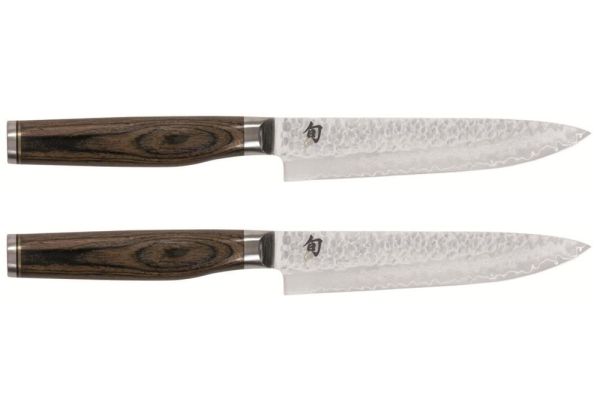
Damascus Steak Knife Set Shun Premier Tim Malzer by KAI
€342.20
€280.49
Availability:
In stock
For the Shun Premier Tim Mälzer Series, Kai has developed a corrosion-resistant table knife with 32 layers of Damascus steel.
The blade is embellished with a hand-hammered surface, known in Japan as Tsuchime, combining timeless aesthetic qualities with exceptional sharpness. The blade has a solid VG-10 steel core with a hardness of 61 ± 1 HRC. The Premier Shun Tim Mälzer is elegant, providing exceptional performance in a timeless design. True to Tim Mälzer's premise, “A good knife not only makes the job easier, but also helps in cooking to turn the product well”.
Thanks to the particularly symmetrical shape of their walnut handles, this knife guarantees precise cutting performance for both right- and left-handed users.
Blade length: 15 cm
Total length: 25.5 cm
The set consists of two knives.
Shipping time: 5-7 days
The blade is embellished with a hand-hammered surface, known in Japan as Tsuchime, combining timeless aesthetic qualities with exceptional sharpness. The blade has a solid VG-10 steel core with a hardness of 61 ± 1 HRC. The Premier Shun Tim Mälzer is elegant, providing exceptional performance in a timeless design. True to Tim Mälzer's premise, “A good knife not only makes the job easier, but also helps in cooking to turn the product well”.
Thanks to the particularly symmetrical shape of their walnut handles, this knife guarantees precise cutting performance for both right- and left-handed users.
Blade length: 15 cm
Total length: 25.5 cm
The set consists of two knives.
Shipping time: 5-7 days
FAQs