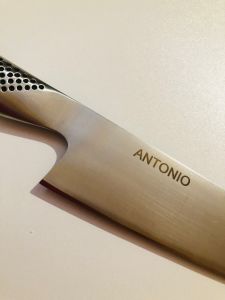
Global 550/GB MinoSharp 3 Ceramic Water SharpenerThree ceramic wheels for even better sharpening, coarse, medium and fine. Recommended for sharpening Global Knives.
FAQs
What does the Global Accessories range include?
The Global Accessories range includes complementary tools such as sharpeners, scissors, tongs, bags and storage solutions designed to enhance kitchen performance.
What is a knife sharpener and who is it for?
It's a tool with a preset angle: you rest or draw the blade through a slot, and the abrasive always works at the same inclination. You don't need to learn to hold the angle by hand, so it suits anyone who wants consistent results quickly, at home or in a kitchen where several people share the same knives. The trade-off is less control than a stone.
What are Global accessories used for?
They support food preparation, knife maintenance and safe storage, helping to maintain consistent performance over time.
Manual or electric?
Manual sharpeners, with ceramic wheels or crossed rods, are compact and quiet and remove little metal, which makes them right for regular maintenance. Electric sharpeners work faster and can also restore badly worn blades, but they remove more steel, so use them when the knife needs it rather than every time. If you sharpen many knives every day, you'll find professional machines in the Sharpening machines category.
Are Global accessories suitable for professional use?
Yes, they are designed for intensive professional use, featuring durable materials and practical solutions for everyday work.
What do the different stages mean?
Many models have two or three stages with different grits. The first, coarser one rebuilds the edge; the last, finer one refines it and evens it out. For a knife in good condition, the fine stage is often enough to bring the edge back. Use the coarse stage only when the blade is genuinely worn, because it removes the most metal.
How should I choose the right accessories?
The choice depends on your workflow: sharpeners for edge maintenance, storage solutions for protection and transport, and tools for preparation tasks.
Is it suitable for Japanese knives?
It depends on the sharpener's angle. Many Japanese knives have a more acute edge than Western ones, and a sharpener set to a wider angle changes it with every pass. Some models work at specific angles, such as the 15° common on many Asian blades; others have separate slots for the two blade types. The working angle is listed on each product page: compare it with your knife's. Single-bevel knives such as deba and yanagiba should be sharpened on a stone.
Can I sharpen serrated knives?
Not with most wheel sharpeners: the slots are designed for a plain edge and can damage the teeth. Some models explicitly state that they handle serrated blades; if the product page doesn't say so, don't use it on this type of knife.
How do I get a good result?
Place the sharpener on a stable surface and draw the blade through from heel to tip without pressing down: the abrasive does the work, not force. Follow the manufacturer's number of passes and order of stages, and don't saw back and forth unless the instructions say so. Afterwards, rinse and dry the blade to remove metal particles before using it on food.
What makes Global knives recognisable?
The seamless stainless steel design and the distinctive dimpled anti-slip handle, combined with thin, well-balanced blades.
Who are Global knives suitable for?
They are ideal for those seeking lightness, manoeuvrability and precision, both in professional kitchens and advanced home use.
What type of maintenance do they require?
Hand washing, immediate drying and regular sharpening are recommended. Avoiding aggressive tools and unsuitable surfaces helps preserve the edge longer.
Which models are considered essential?
A main knife (chef or gyuto), a paring knife and a serrated bread knife cover most kitchen needs.