WORLDWIDE SHIPPING

 IT
IT FR
FR





 IT
IT FR
FR Share
Share

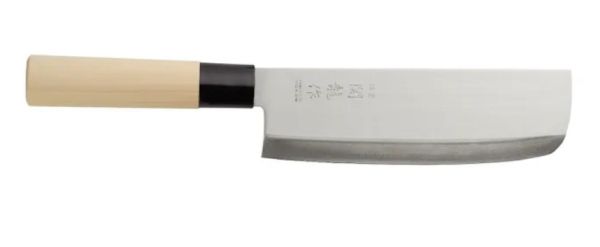
Japanese Nakiri knife cm. 18 by Hendi
€42.00
€34.43
Availability:
In stock
The Hendi 18 cm Japanese Nakiri Knife is an essential tool for those who like to prepare vegetables and herbs with precision. Featuring a straight cutting edge and no sharp point, this knife has a thin, wide square blade, making it ideal for cutting vegetables into very thin slices. Its unique design allows for clean, precise cuts, perfect for obtaining even and easily manageable slices.
The width of the blade allows you to quickly move ingredients from the work surface to the pot or plate, while the sharp edge on both sides ensures optimal performance and effortless ease of use. The shape without a sharp point is perfect for cutting vegetables, herbs and chopped ingredients, while the blade allows for extremely precise slicing.
Crafted from Japanese SUS 420J2 stainless steel with a hardness of approximately 53 HRC, this knife offers superior strength and durability. The poplar wood handle is designed to ensure a secure and comfortable grip, optimising control during use. The traditional Japanese design gives this knife an elegant look, being part of a complete line of tools perfect for preparing sushi and more.
Ideal for those looking for a high-quality knife to cut and slice vegetables with precision, the Nakiri Hendi is a tool that cannot be missing in a professional kitchen. It is recommended not to wash it in the dishwasher to keep the blade in perfect condition.
Made in Japan
Handle: poplar wood
Blade length: cm. 18
Delivery time: 2-3 days
FAQs