WORLDWIDE SHIPPING

 IT
IT FR
FR



 IT
IT FR
FR Share
Share

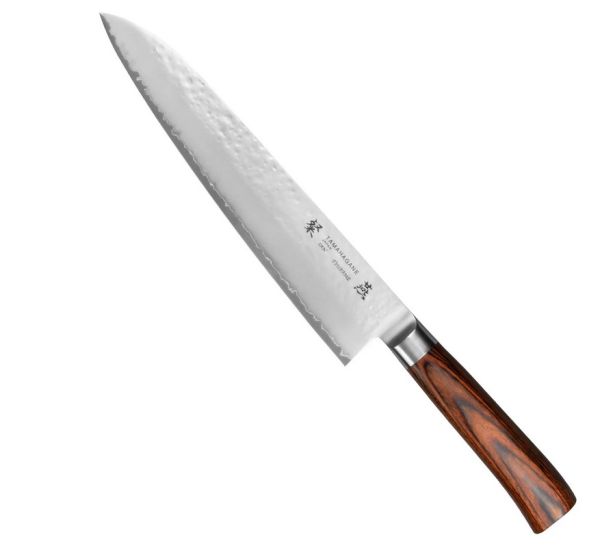
Kitchen knife cm. 24 Tsubame Pakkawood line by Tamahagane
€186.00
€152.46
Availability:
In stock
Chef's knife with blade length cm. 24 of the Tsubame Pakkawood Line, Tamahagane brand, is built by the Japanese company Kataoka from Niigata, Japan. This knife was designed and used for separating massive cuts of beef. It is perfect for most slicing, dicing and dicing tasks, but also for cutting thick vegetables and dense meats. The curved blade allows you to swing the knife across a cutting board to quickly chop fruits and vegetables.
The 24 cm San Mai blade with VG-5 core with a hardness of 61 HRC, the external part is made of SUS410 steel with Rockwell Hardness 58. There are three layers of steel that give resistance and cutting to the product. The forged blade /Tsuchime/ is engraved and its surface creates a beautiful satin effect. The elegant handle is made of stabilized pakka wood. The construction of this sheet blade is achieved by compression of the two steels. The raw material of 3 layers of total thickness 20.0mm is brought to a thinner thickness of 2.0mm to 2.9mm with repeated rolling processes.
Model: Tamahagane Tsubame 3-layer steel
Type: Chef Knife
Blade length: 24 cm
Handle material: Brown Pakkawood
Blade: SAN MAI stainless steel 3 layers of VG5 - HRC61 (inside)
Delivery time: 5-7 days
FAQs