WORLDWIDE SHIPPING

 IT
IT FR
FR



 IT
IT FR
FR Share
Share

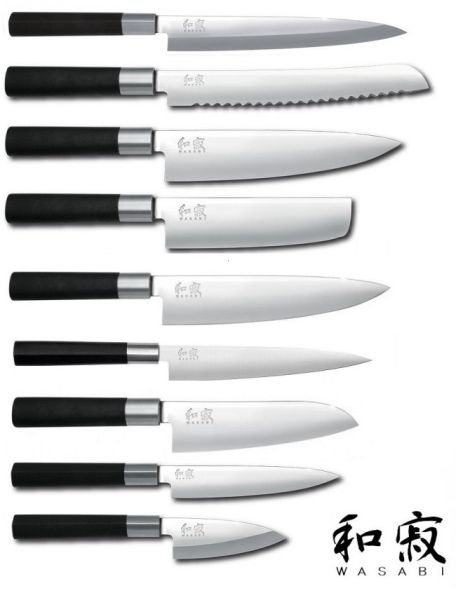
Professional cook set consisting of 9 Wasabi Black knives
was
€538.50
Special Price
€484.00
€396.72
Availability:
In stock
Professional cook set consisting of 9 Wasabi Black knives
The Wasabi Black line by Kai has a shiny blade, black handle.
The knives, produced in Japan, with a polished stainless steel blade with hardness 58 + - HRD, will give each kitchen an exclusive atmosphere of the Far East.
For this series Kai has studied a handle of a particular combination of bamboo powder and propylene that offers excellent hygiene characteristics, also for the natural antibacterial effect of the bamboo.
The handle completely encloses the blade, preventing each deposit between blade and handle.
The Set includes:
n. 1 Yanagiba 6721Y knife, blade 21 cm, handle 12.6 cm suitable for cutting raw fish
n. 1 Bread knife 6723B, Blade 23 cm, Handle 12.6 cm. ideal for cutting bakery products
n. 1 Chef knife 6723C, Blade 23 cm, Handle 12.6 cm. suitable for all cuts in the kitchen, slicing, mincing
n. 1 Nakiri 6716N knife, Blade 16.5 cm, Handle 12.6 cm. perfect for cutting vegetables
n. 1 Chef knife 6720C, Blade 20 cm, Handle 12.6 cm. to mince and chop
n. 1 Filleting knife 6761F, Blade 20 cm. Handle 12.6 cm. perfect for filleting and scalloping
n. 1 Santoku knife 6716S, Blade 16 cm, Handle 12.6 cm for small vegetables and slicing raw meats
n. 1 Universal knife 6715U, blade 15 cm, handle 12.6 cm, suitable for scalloping or trimming meat
n. 1 Deba 6710D knife, 10.5 cm blade, 12.6 cm handle Excellent for important cuts such as fish head.
The knives, produced in Japan, with a polished stainless steel blade with hardness 58 + - HRD, will give each kitchen an exclusive atmosphere of the Far East.
For this series Kai has studied a handle of a particular combination of bamboo powder and propylene that offers excellent hygiene characteristics, also for the natural antibacterial effect of the bamboo.
The handle completely encloses the blade, preventing each deposit between blade and handle.
The Set includes:
n. 1 Yanagiba 6721Y knife, blade 21 cm, handle 12.6 cm suitable for cutting raw fish
n. 1 Bread knife 6723B, Blade 23 cm, Handle 12.6 cm. ideal for cutting bakery products
n. 1 Chef knife 6723C, Blade 23 cm, Handle 12.6 cm. suitable for all cuts in the kitchen, slicing, mincing
n. 1 Nakiri 6716N knife, Blade 16.5 cm, Handle 12.6 cm. perfect for cutting vegetables
n. 1 Chef knife 6720C, Blade 20 cm, Handle 12.6 cm. to mince and chop
n. 1 Filleting knife 6761F, Blade 20 cm. Handle 12.6 cm. perfect for filleting and scalloping
n. 1 Santoku knife 6716S, Blade 16 cm, Handle 12.6 cm for small vegetables and slicing raw meats
n. 1 Universal knife 6715U, blade 15 cm, handle 12.6 cm, suitable for scalloping or trimming meat
n. 1 Deba 6710D knife, 10.5 cm blade, 12.6 cm handle Excellent for important cuts such as fish head.
FAQs