WORLDWIDE SHIPPING

 IT
 FR

- KNIVES
- JAPANESE KNIVES
- EUROPEAN KNIVES
- PROMOTIONAL AND CUSTOMIZATIONS
- CHEF'S CASES - KNIVES BLOCKS - SETS
- SHARPENING
- PASTRY
- PASTRY UTENSILS
- ACCESSORIES & UTENSILS
- CAKE STANDS AND DISPLAY
- CHOCOLATE
- MARTELLATO PROFESSIONAL
- PAVONI ITALIA
- BRUSHES, SPATULAS AND WHIPS
- SCHNEIDER
- SILICONE
- SILIKOMART PROFESSIONAL
- AIRPLUS
- CHOCADO
- ÉCLAIR
- DECORATIVE ELEMENTS
- FRUITS 3D
- ICE
- MINI DESSERTS - MIGNON
- MODERN SINGLE PORTIONS
- CLASSIC SINGLE PORTIONS AND CAKES
- NATURAE
- 60 X 40 MOLDS
- AIR MAT
- TARTE 4.0
- JELLY MOULDS
- MODERN CAKES
- STORAGE AND DISPLAY I-GLOO AND MACADO'
- MOULDS FOR CHOCOLATES
- CHOCOLATE ACCESSORIES
- SMALL PLATES
- ACCESSORIES
- CRAFT MOULDS
- PASTRY CUTTER
- TRAYS, GRADE, BOWLS, JUGS, BOTTLES
- THERMOMETERS, TIMER AND SCALES
- BAKEWARE, RINGS AND MOULDS
- MOULDS
- PACKAGING AND PASTRY TRAYS
- BAKING MATS & LINERS
- GUITARS - FRAMES
- VALENTINE'S DAY - MOTHER'S DAY
- DECORATING CAKES
- ICE-CREAM SHOP
- PASTRY UTENSILS
- KITCHEN
- WELLNESS KITCHEN
- COOKING UTENSILS
- ELECTRIC KITCHEN UTENSILS
- POTS
- CARVING & DECORATION
- MANDOLINE AND GRATERS
- ETHNIC CUISINE
- CATERING & BUFFET
- COOKING BOOKS

- CLOTHING
- TABLE & BAR
- HOME & FREE TIME
- GIFT IDEAS
- NEWS
- BLACK FRIDAY
- SPARE PARTS
- DELUXE
- AFCOLTELLERIE Home
- Blog
- Business

 IT
 FR


Related Products
FREE SHIPPING
on orders over €99,00 to Italy and over €199,00 to Europe
CUSTOMER CARE
AFcoltellerie Customer Service offers support before, during and after the purchase process.
Write to info@afcoltellerie.com
AF_FIDELITY
Check out our loyalty program!
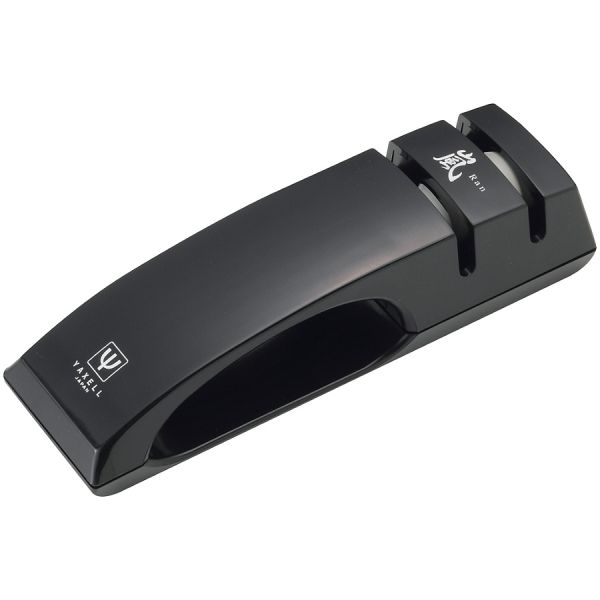
Affilatoio Ran Affilacoltelli Nero
€53.00
€43.44
Availability:
In stock
Affilatoio Ran Affilacoltelli Nero, dispositivo di affilatura in ossido di alluminio #400 per ravvivare il filo dei Vostri coltelli con facilita e senza bisogno di conoscere l'inclinazione di affilatura.
Struttura esterna in ABS lucido resistente agli urti.
Dimensioni: 18 cm x 5 cm
Colore Nero
FAQs
What is the ideal length for a chef's knife?
The most common length for a chef's knife is 20 cm (8 inches), which is perfect for most kitchen tasks.
However, the ideal choice depends on several factors:
Hand size: Smaller hands handle 16–18 cm blades more comfortably, while larger hands may prefer a 21–25 cm blade.
Personal habits: Those who favor broad movements and long cuts might lean toward longer knives; those who prioritize precision or work in tight spaces might prefer a shorter blade.
Experience level: Beginners tend to choose shorter, more manageable blades, while professionals often prefer 21 or 24 cm knives for greater efficiency.
In short, there is no “perfect” size for everyone — the right length should be chosen based on comfort, control, and intended use.
What’s the best way to store kitchen knives?
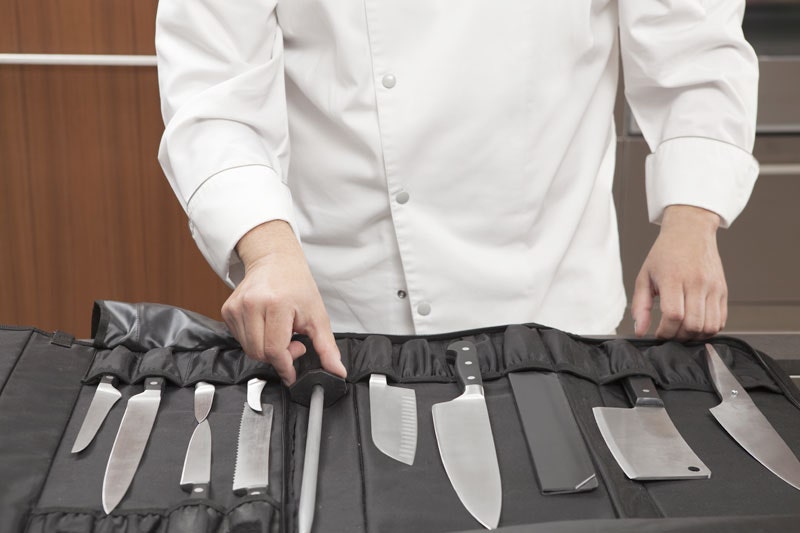
Avoid keeping them loose in drawers, where they can get damaged or become a safety hazard. It’s better to use a wooden block, magnetic strip, or blade guard. You can find the right solution in our catalog.
Do you have professional chef knives?
Yes, in our ecommerce store you will find only professional and high-quality chef knives.
Each model is selected to meet the needs of chefs, cooks, and cooking enthusiasts who seek reliable, sharp, and durable tools.
We offer a complete range of professional kitchen knives, ideal for precision cutting, meat, fish, vegetables, and much more.
You will find slicing knives, santoku, paring knives, and other models commonly used in professional kitchens.
We collaborate only with brands recognized at the professional level, such as [e.g., Victorinox, Global, Kai, F. Dick, Ambrogio Sanelli, Wüsthof, etc.], to offer you the best in performance and safety in the kitchen
Can I put knives in the dishwasher?
It’s highly discouraged. High heat and aggressive detergents can damage both blade and handle. Knives can also knock against other items, dulling the edge.
What does "blade hardness" mean?
Hardness refers to how resistant the steel is, measured on the Rockwell scale (HRC). The harder the steel, the better it retains its edge—but it’s also more brittle and prone to chipping.
What materials are used for knife blades?
Blades can be made of stainless steel (rust-resistant), carbon steel (very sharp but delicate), or ceramic (lightweight and razor-sharp but fragile). Premium knives often use Damascus steel or advanced alloys. Not sure which to choose? Contact us—AFcoltellerie has them all.
What are knife handles made of?
Handles can be made of wood (classic but delicate), plastic (durable and hygienic), or technical materials like micarta or G-10, which are extremely tough and non-slip even when wet.
What’s the best knife for beginners?
A 20 cm chef’s knife is the most versatile option to start with. Paired with a paring knife, it covers most everyday kitchen needs.
What are the grooves (granton edge) on a blade for?
The grooves or “granton edge” reduce friction and prevent food from sticking to the blade. They’re especially useful with wet or soft foods like fish, cheese, or vegetables.
Are there knives for left-handed users?
Yes. Some single-bevel Japanese knives are made specifically for right- or left-handed use. Many universal knives, with a double bevel, work well for both.
European or Japanese knives: what’s the difference?
European knives are sturdier, with thick, curved blades for rocking cuts and tough ingredients. Japanese knives have thinner, harder blades for clean, precise slicing—but they’re also more fragile. In short: Europeans are durable and versatile, Japanese are sharp and surgical.
Why is it important to sharpen knives?
A sharp knife is safer and more efficient: it requires less force and delivers precise cuts. A dull blade can slip and increase the risk of accidents.
How often should I sharpen my knives?
It depends on how often you use them and the type of blade. Generally, regular honing with a honing steel is recommended, along with deeper sharpening every few months or when the knife loses effectiveness.
Should I use a honing steel or a sharpener?
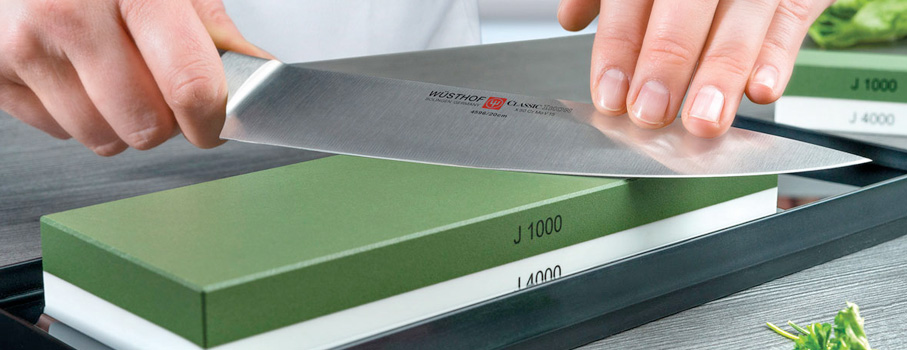
A honing steel maintains the edge and prolongs the life of the knife, but it doesn’t actually sharpen. To restore the edge, you need a sharpener (manual, electric, or whetstone). The ideal routine is to use both: the honing steel for daily care, the sharpener for periodic maintenance.
What’s the difference between a smooth, grooved, or ceramic honing steel?
A smooth steel realigns the edge without removing metal. A grooved one has a slightly abrasive action, taking off a small amount of material. A ceramic steel is gentler and suitable even for hard blades like Japanese knives.
How do you correctly use a honing steel?
Hold the steel vertically and draw the blade across both sides at a 15–20° angle using light, steady strokes. Just a few passes are enough to maintain the edge.
Can I sharpen any type of knife?
Almost all types, but be careful with serrated or ceramic blades: they require specific tools or techniques. Always check the manufacturer's guidelines or ask us for advice.
What is a knife sharpener and who is it for?
It's a tool with a preset angle: you rest or draw the blade through a slot, and the abrasive always works at the same inclination. You don't need to learn to hold the angle by hand, so it suits anyone who wants consistent results quickly, at home or in a kitchen where several people share the same knives. The trade-off is less control than a stone.
Manual or electric?
Manual sharpeners, with ceramic wheels or crossed rods, are compact and quiet and remove little metal, which makes them right for regular maintenance. Electric sharpeners work faster and can also restore badly worn blades, but they remove more steel, so use them when the knife needs it rather than every time. If you sharpen many knives every day, you'll find professional machines in the Sharpening machines category.
What do the different stages mean?
Many models have two or three stages with different grits. The first, coarser one rebuilds the edge; the last, finer one refines it and evens it out. For a knife in good condition, the fine stage is often enough to bring the edge back. Use the coarse stage only when the blade is genuinely worn, because it removes the most metal.
Is it suitable for Japanese knives?
It depends on the sharpener's angle. Many Japanese knives have a more acute edge than Western ones, and a sharpener set to a wider angle changes it with every pass. Some models work at specific angles, such as the 15° common on many Asian blades; others have separate slots for the two blade types. The working angle is listed on each product page: compare it with your knife's. Single-bevel knives such as deba and yanagiba should be sharpened on a stone.
Can I sharpen serrated knives?
Not with most wheel sharpeners: the slots are designed for a plain edge and can damage the teeth. Some models explicitly state that they handle serrated blades; if the product page doesn't say so, don't use it on this type of knife.
How do I get a good result?
Place the sharpener on a stable surface and draw the blade through from heel to tip without pressing down: the abrasive does the work, not force. Follow the manufacturer's number of passes and order of stages, and don't saw back and forth unless the instructions say so. Afterwards, rinse and dry the blade to remove metal particles before using it on food.
What truly distinguishes Yaxell knives within the Japanese knife market?
Yaxell occupies a very specific position: it is one of the brands that most effectively translates Japanese knife-making tradition into a high-quality industrial product, while maintaining both consistency and accessibility. Unlike fully handcrafted knives, Yaxell relies on controlled processes and modern steels such as VG-10 and SG2 to achieve high and consistent performance. The result is a blade that combines Damascus-style aesthetics, high hardness, and stable cutting performance, without entering the extreme complexity of more elite artisanal knives.
What is the real philosophy behind the Yaxell brand?
Yaxell’s philosophy is not just about Japanese tradition, but about making that tradition practical and usable at scale. Each knife is designed to deliver precise cutting, long-lasting edge stability, and strong perceived quality, including visual appeal, while maintaining consistency and reliability through industrial production.
How should the differences between Yaxell series be understood?
The main differences lie in the type of steel (VG-10 vs SG2), blade rigidity, and edge retention. VG-10 lines offer a balance between performance and ease of use, while SG2 lines represent a clear step up in performance, with higher hardness, longer edge life, and greater cutting precision.
Who are Yaxell knives recommended for?
Yaxell covers a wide range of users, from those entering the world of Japanese knives to advanced professionals. It is an ideal choice for anyone looking for high performance that remains manageable in everyday use.
What are they ideal for?
They excel in precision cutting, repetitive preparation tasks, and continuous use. The more advanced series offer greater stability and consistency during extended work sessions.
What is the correct maintenance approach?
Hand wash, dry immediately, and sharpen regularly using whetstones. SG2 series require more attention due to their higher hardness.
What distinguishes Japanese knives from Western ones?
Thinner geometries, sharper edge angles and an approach focused on precision and clean cutting.