WORLDWIDE SHIPPING

 IT
IT FR
FR



 IT
IT FR
FR Share
Share

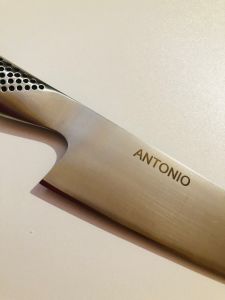

Global SAI-M01 Chef's Knife, 5-1/2"/cm. 14
€139.00
€113.93
Availability:
In stock
Global SAI knives are made by the Japanese artisans who produce Global knives in the Yoshikin factory and are manufactured with three layers of stainless steel.
All the experience acquired in the production of hollow stainless steel handles and the modern technology in the manufacture of knives have been applied to the producion of the new GLOBAL SAI knives.
Designed by Komin Yamada, with an experience of 25 years in this field, the knives have three excellent functionalities :
they are elegant, ergonomic and made in high quality steel.
Blades are made in special steel with the central blade of exceptional hardness of 58-59 Rockwell, with an excellent carving and the two outer layers are in stainless steel SUS419 resistant to corrosion.
The hammered finishing makes the knives very elegant and hard to believe helps avoiding that the food cut sticks to the blade, making the cut more slipping.
This cook knife has a blade length of cm. 14 and is fit to cut vegetables and fruits as well as small loaves of fish and meat.
All the experience acquired in the production of hollow stainless steel handles and the modern technology in the manufacture of knives have been applied to the producion of the new GLOBAL SAI knives.
Designed by Komin Yamada, with an experience of 25 years in this field, the knives have three excellent functionalities :
they are elegant, ergonomic and made in high quality steel.
Blades are made in special steel with the central blade of exceptional hardness of 58-59 Rockwell, with an excellent carving and the two outer layers are in stainless steel SUS419 resistant to corrosion.
The hammered finishing makes the knives very elegant and hard to believe helps avoiding that the food cut sticks to the blade, making the cut more slipping.
This cook knife has a blade length of cm. 14 and is fit to cut vegetables and fruits as well as small loaves of fish and meat.
FAQs