Yaxell Japanese knife sharpener with # 400 aluminum oxide sharpening device, perfect for reviving the edge of your damask knives, without having to know the right cutting angle.
External structure in ABS, impact resistant.
Duracon support pin for grinding wheels.
Upper protection in polycarbonate.
FAQs
Why is it important to sharpen knives?
A sharp knife is safer and more efficient: it requires less force and delivers precise cuts. A dull blade can slip and increase the risk of accidents.
How often should I sharpen my knives?
It depends on how often you use them and the type of blade. Generally, regular honing with a honing steel is recommended, along with deeper sharpening every few months or when the knife loses effectiveness.
Should I use a honing steel or a sharpener?
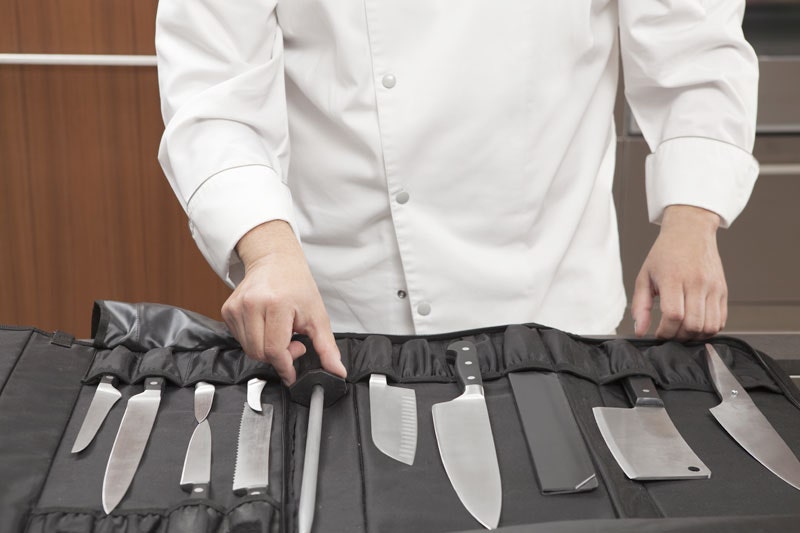
A honing steel maintains the edge and prolongs the life of the knife, but it doesn’t actually sharpen. To restore the edge, you need a sharpener (manual, electric, or whetstone). The ideal routine is to use both: the honing steel for daily care, the sharpener for periodic maintenance.
What’s the difference between a smooth, grooved, or ceramic honing steel?
A smooth steel realigns the edge without removing metal. A grooved one has a slightly abrasive action, taking off a small amount of material. A ceramic steel is gentler and suitable even for hard blades like Japanese knives.
How do you correctly use a honing steel?
Hold the steel vertically and draw the blade across both sides at a 15–20° angle using light, steady strokes. Just a few passes are enough to maintain the edge.
Can I sharpen any type of knife?
Almost all types, but be careful with serrated or ceramic blades: they require specific tools or techniques. Always check the manufacturer's guidelines or ask us for advice.
What is a knife sharpener and who is it for?
It's a tool with a preset angle: you rest or draw the blade through a slot, and the abrasive always works at the same inclination. You don't need to learn to hold the angle by hand, so it suits anyone who wants consistent results quickly, at home or in a kitchen where several people share the same knives. The trade-off is less control than a stone.
Manual or electric?
Manual sharpeners, with ceramic wheels or crossed rods, are compact and quiet and remove little metal, which makes them right for regular maintenance. Electric sharpeners work faster and can also restore badly worn blades, but they remove more steel, so use them when the knife needs it rather than every time. If you sharpen many knives every day, you'll find professional machines in the Sharpening machines category.
What do the different stages mean?
Many models have two or three stages with different grits. The first, coarser one rebuilds the edge; the last, finer one refines it and evens it out. For a knife in good condition, the fine stage is often enough to bring the edge back. Use the coarse stage only when the blade is genuinely worn, because it removes the most metal.
Is it suitable for Japanese knives?
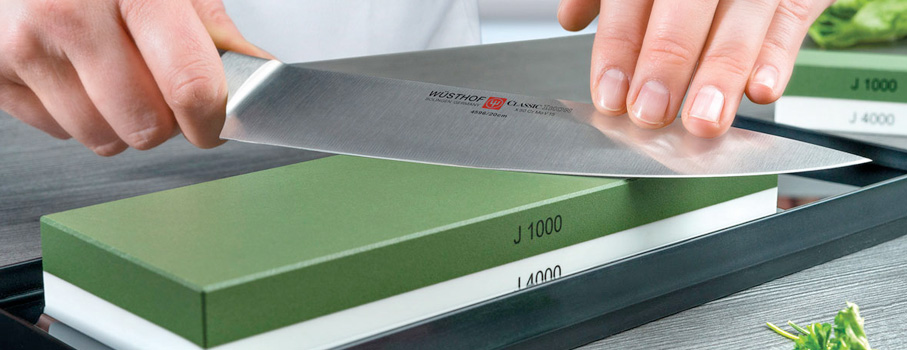
It depends on the sharpener's angle. Many Japanese knives have a more acute edge than Western ones, and a sharpener set to a wider angle changes it with every pass. Some models work at specific angles, such as the 15° common on many Asian blades; others have separate slots for the two blade types. The working angle is listed on each product page: compare it with your knife's. Single-bevel knives such as deba and yanagiba should be sharpened on a stone.
Can I sharpen serrated knives?
Not with most wheel sharpeners: the slots are designed for a plain edge and can damage the teeth. Some models explicitly state that they handle serrated blades; if the product page doesn't say so, don't use it on this type of knife.
How do I get a good result?
Place the sharpener on a stable surface and draw the blade through from heel to tip without pressing down: the abrasive does the work, not force. Follow the manufacturer's number of passes and order of stages, and don't saw back and forth unless the instructions say so. Afterwards, rinse and dry the blade to remove metal particles before using it on food.
What truly distinguishes Yaxell knives within the Japanese knife market?
Yaxell occupies a very specific position: it is one of the brands that most effectively translates Japanese knife-making tradition into a high-quality industrial product, while maintaining both consistency and accessibility. Unlike fully handcrafted knives, Yaxell relies on controlled processes and modern steels such as VG-10 and SG2 to achieve high and consistent performance. The result is a blade that combines Damascus-style aesthetics, high hardness, and stable cutting performance, without entering the extreme complexity of more elite artisanal knives.
What is the real philosophy behind the Yaxell brand?
Yaxell’s philosophy is not just about Japanese tradition, but about making that tradition practical and usable at scale. Each knife is designed to deliver precise cutting, long-lasting edge stability, and strong perceived quality, including visual appeal, while maintaining consistency and reliability through industrial production.
How should the differences between Yaxell series be understood?
The main differences lie in the type of steel (VG-10 vs SG2), blade rigidity, and edge retention. VG-10 lines offer a balance between performance and ease of use, while SG2 lines represent a clear step up in performance, with higher hardness, longer edge life, and greater cutting precision.
Who are Yaxell knives recommended for?
Yaxell covers a wide range of users, from those entering the world of Japanese knives to advanced professionals. It is an ideal choice for anyone looking for high performance that remains manageable in everyday use.
What are they ideal for?
They excel in precision cutting, repetitive preparation tasks, and continuous use. The more advanced series offer greater stability and consistency during extended work sessions.
What is the correct maintenance approach?
Hand wash, dry immediately, and sharpen regularly using whetstones. SG2 series require more attention due to their higher hardness.