WORLDWIDE SHIPPING

 IT
 FR

- KNIVES
- JAPANESE KNIVES
- EUROPEAN KNIVES
- PROMOTIONAL AND CUSTOMIZATIONS
- CHEF'S CASES - KNIVES BLOCKS - SETS
- SHARPENING
- PASTRY
- PASTRY UTENSILS
- ACCESSORIES & UTENSILS
- CAKE STANDS AND DISPLAY
- CHOCOLATE
- MARTELLATO PROFESSIONAL
- PAVONI ITALIA
- BRUSHES, SPATULAS AND WHIPS
- SCHNEIDER
- SILICONE
- SILIKOMART PROFESSIONAL
- AIRPLUS
- CHOCADO
- ÉCLAIR
- DECORATIVE ELEMENTS
- FRUITS 3D
- ICE
- MINI DESSERTS - MIGNON
- MODERN SINGLE PORTIONS
- CLASSIC SINGLE PORTIONS AND CAKES
- NATURAE
- 60 X 40 MOLDS
- AIR MAT
- TARTE 4.0
- JELLY MOULDS
- MODERN CAKES
- STORAGE AND DISPLAY I-GLOO AND MACADO'
- MOULDS FOR CHOCOLATES
- CHOCOLATE ACCESSORIES
- SMALL PLATES
- ACCESSORIES
- CRAFT MOULDS
- PASTRY CUTTER
- TRAYS, GRADE, BOWLS, JUGS, BOTTLES
- THERMOMETERS, TIMER AND SCALES
- BAKEWARE, RINGS AND MOULDS
- MOULDS
- PACKAGING AND PASTRY TRAYS
- BAKING MATS & LINERS
- GUITARS - FRAMES
- VALENTINE'S DAY - MOTHER'S DAY
- DECORATING CAKES
- ICE-CREAM SHOP
- PASTRY UTENSILS
- KITCHEN
- WELLNESS KITCHEN
- COOKING UTENSILS
- ELECTRIC KITCHEN UTENSILS
- POTS
- CARVING & DECORATION
- MANDOLINE AND GRATERS
- ETHNIC CUISINE
- CATERING & BUFFET
- COOKING BOOKS

- CLOTHING
- TABLE & BAR
- HOME & FREE TIME
- GIFT IDEAS
- NEWS
- SALES
- SPARE PARTS
- DELUXE
- AFCOLTELLERIE Home
- Blog
- Business

 IT
 FR


Related Products
FREE SHIPPING
on orders over €99,00 to Italy and over €199,00 to Europe
CUSTOMER CARE
AFcoltellerie Customer Service offers support before, during and after the purchase process.
Write to info@afcoltellerie.com
AF_FIDELITY
Check out our loyalty program!

KAI Diamond grindstone Grain 3000 with small basin
€56.00
€45.90
Availability:
In stock
KAI Diamond grindstone Grain 3000
The surface of the new diamonded stone AP-0306 has a grain of about 3000.
With respect to the traditional stones it is an optimal solution to sharpen knives slightly blunted.
Stone dimensions 25,2x9,4x3,5 cm
With respect to the traditional stones it is an optimal solution to sharpen knives slightly blunted.
Stone dimensions 25,2x9,4x3,5 cm
FAQs
What is the ideal length for a chef's knife?
The most common length for a chef's knife is 20 cm (8 inches), which is perfect for most kitchen tasks.
However, the ideal choice depends on several factors:
Hand size: Smaller hands handle 16–18 cm blades more comfortably, while larger hands may prefer a 21–25 cm blade.
Personal habits: Those who favor broad movements and long cuts might lean toward longer knives; those who prioritize precision or work in tight spaces might prefer a shorter blade.
Experience level: Beginners tend to choose shorter, more manageable blades, while professionals often prefer 21 or 24 cm knives for greater efficiency.
In short, there is no “perfect” size for everyone — the right length should be chosen based on comfort, control, and intended use.
What’s the best way to store kitchen knives?
Avoid keeping them loose in drawers, where they can get damaged or become a safety hazard. It’s better to use a wooden block, magnetic strip, or blade guard. You can find the right solution in our catalog.
Do you have professional chef knives?
Yes, in our ecommerce store you will find only professional and high-quality chef knives.
Each model is selected to meet the needs of chefs, cooks, and cooking enthusiasts who seek reliable, sharp, and durable tools.
We offer a complete range of professional kitchen knives, ideal for precision cutting, meat, fish, vegetables, and much more.
You will find slicing knives, santoku, paring knives, and other models commonly used in professional kitchens.
We collaborate only with brands recognized at the professional level, such as [e.g., Victorinox, Global, Kai, F. Dick, Ambrogio Sanelli, Wüsthof, etc.], to offer you the best in performance and safety in the kitchen
Can I put knives in the dishwasher?
It’s highly discouraged. High heat and aggressive detergents can damage both blade and handle. Knives can also knock against other items, dulling the edge.
What does "blade hardness" mean?
Hardness refers to how resistant the steel is, measured on the Rockwell scale (HRC). The harder the steel, the better it retains its edge—but it’s also more brittle and prone to chipping.
What materials are used for knife blades?
Blades can be made of stainless steel (rust-resistant), carbon steel (very sharp but delicate), or ceramic (lightweight and razor-sharp but fragile). Premium knives often use Damascus steel or advanced alloys. Not sure which to choose? Contact us—AFcoltellerie has them all.
What are knife handles made of?
Handles can be made of wood (classic but delicate), plastic (durable and hygienic), or technical materials like micarta or G-10, which are extremely tough and non-slip even when wet.
What’s the best knife for beginners?
A 20 cm chef’s knife is the most versatile option to start with. Paired with a paring knife, it covers most everyday kitchen needs.
What are the grooves (granton edge) on a blade for?
The grooves or “granton edge” reduce friction and prevent food from sticking to the blade. They’re especially useful with wet or soft foods like fish, cheese, or vegetables.
Are there knives for left-handed users?
Yes. Some single-bevel Japanese knives are made specifically for right- or left-handed use. Many universal knives, with a double bevel, work well for both.
European or Japanese knives: what’s the difference?
European knives are sturdier, with thick, curved blades for rocking cuts and tough ingredients. Japanese knives have thinner, harder blades for clean, precise slicing—but they’re also more fragile. In short: Europeans are durable and versatile, Japanese are sharp and surgical.
Why is it important to sharpen knives?
A sharp knife is safer and more efficient: it requires less force and delivers precise cuts. A dull blade can slip and increase the risk of accidents.
How often should I sharpen my knives?
It depends on how often you use them and the type of blade. Generally, regular honing with a honing steel is recommended, along with deeper sharpening every few months or when the knife loses effectiveness.
Should I use a honing steel or a sharpener?
A honing steel maintains the edge and prolongs the life of the knife, but it doesn’t actually sharpen. To restore the edge, you need a sharpener (manual, electric, or whetstone). The ideal routine is to use both: the honing steel for daily care, the sharpener for periodic maintenance.
What’s the difference between a smooth, grooved, or ceramic honing steel?
A smooth steel realigns the edge without removing metal. A grooved one has a slightly abrasive action, taking off a small amount of material. A ceramic steel is gentler and suitable even for hard blades like Japanese knives.
How do you correctly use a honing steel?
Hold the steel vertically and draw the blade across both sides at a 15–20° angle using light, steady strokes. Just a few passes are enough to maintain the edge.
Can I sharpen any type of knife?
Almost all types, but be careful with serrated or ceramic blades: they require specific tools or techniques. Always check the manufacturer's guidelines or ask us for advice.
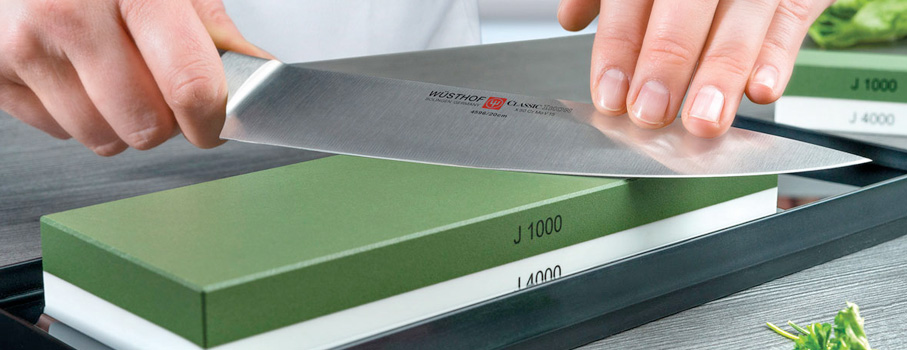
What are sharpening stones for?
A stone removes steel from the edge and rebuilds it. It gives more control than any other method: your hand sets the angle, not a fixed slot, so it works on Western and Japanese knives and on different thicknesses and profiles. It takes some practice, but it also wastes the least steel, because you only work where the edge needs it.
What characterizes the KAI ACCESSORIES series?
The KAI ACCESSORIES series brings together tools designed to support every stage of kitchen work: from ingredient preparation — with utensils such as peelers and tongs — to blade care, thanks to sharpening stones developed to KAI's exacting standards. Each accessory is crafted with the same attention to quality and functionality that defines the brand's entire range.
Which grit should I choose?
Grit measures how fine the abrasive is: the higher the number, the finer the stone. Below #400, stones are used to repair small chips or a badly damaged edge; between #800 and #1500 is where the actual sharpening happens; from #3000 upwards, stones refine and polish the edge. For a first stone, a 1000/3000 or 1000/6000 combination stone is the most versatile starting point.
Who is this series recommended for?
It is suitable for both professionals and cooking enthusiasts who want to complete their kitchen kit with reliable, precise and long-lasting tools that integrate seamlessly with KAI knives.
Water stones, oil stones or diamond stones: what's the difference?
Water stones are the most common choice for kitchen knives: they cut quickly and work with a film of water that carries away the residue. Some need soaking before use, others only need wetting on the surface; each stone's product page says which. Oil stones cut more slowly and need the lubricant specified by the manufacturer. Diamond stones remove steel very quickly, stay flat for a long time and also suit very hard steels.
What is the ideal use?
Preparation utensils such as peelers and tongs are designed for intensive daily use, while sharpening stones are ideal for those who want to keep their blades in optimal condition over time, with precise edge control.
What angle should I hold on the stone?
The knife's original one. As a rough guide, many Western knives are sharpened at 15 to 20° per side and many Japanese knives at 10 to 15°, but the exact figure depends on the model and should be checked against the manufacturer's specifications. Holding the angle steady through every stroke matters more than hitting an exact number: a wobbling angle rounds the edge. A clip-on guide on the spine helps in the first sessions.
How should these accessories be properly maintained?
Kitchen utensils should be cleaned after each use, and hand washing is recommended to preserve the materials. Sharpening stones require thorough rinsing after use and should be stored dry; some types need to be soaked before use — always follow the specific product instructions.
How do I know the sharpening has worked?
As you work one side, a thin burr forms on the opposite side. You can feel it by gently drawing a fingertip across the edge, from the spine outwards, never along it. Once the burr runs the full length of the blade, switch sides, then move to finer grits to reduce it. A well-finished edge slices a sheet of paper cleanly, without tearing it.
How do I look after a sharpening stone?
Rinse it after use and let it air-dry away from direct heat; don't put it back in its box while damp. Over time the surface wears hollow in the middle, and on a stone that is no longer flat you can't hold a steady angle: a flattening stone brings it back to flat. It also helps to keep stones of different grits apart, because coarse grit residue scratches the work of a fine stone.
What characterises the KAI series?
The KAI series stands out for the combination of Japanese tradition and modern manufacturing, providing reliable knives for conscious and precise kitchen use.
Who is this series recommended for?
It is suitable for professionals and advanced enthusiasts seeking consistent performance and quality.
What type of use is it ideal for?
It is ideal for everyday preparation and precise cutting tasks.