WORLDWIDE SHIPPING

 IT
IT FR
FR




 IT
IT FR
FR Share
Share


Kai Yanagiba Knife cm. 27 Shun Pro Sho
€283.00
€231.97
Availability:
Out of stock
Yanagiba is a knife structured and manufactured by Japanese masters in their cooking story for fish preparation.
Yanagiba means willow blade in Japanese, the knife is long and thin like a willow leaf and is used to prepare Sashimi, the raw fish.
The knife must be long, since the technical process requires a neat cut to slice fish.
Japanese people think that this makes less damage to the fish and betters its presentation with respect to the cut made with a forward-backward movement.
The length of the blade is of 27 cm.
The knives of the series Kai Shun Pro Sho have a particular characteristic of quality, i.e. the blade in stainless steel VG10, a steel used for the Damascene Shun blades.
The hardness degree of steel is of 61(±1) HRC.
The Kai Shun knives have an ergonomic handle in Pakka wood, imbued with phenolic thermo-hardening resins and has a "D" shape, preventing slipping and the torsion of the handle and allowing a good grip of the knife.
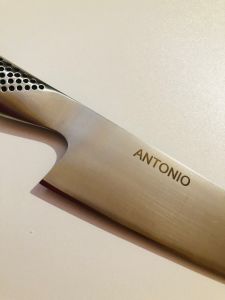
This series Shun Pro Sho has a decorative design engraved on the blade and a mirror finishing that improves in an excellent way the cutting slip.
Delivery time : 7 days
Yanagiba means willow blade in Japanese, the knife is long and thin like a willow leaf and is used to prepare Sashimi, the raw fish.
The knife must be long, since the technical process requires a neat cut to slice fish.
Japanese people think that this makes less damage to the fish and betters its presentation with respect to the cut made with a forward-backward movement.
The length of the blade is of 27 cm.
The knives of the series Kai Shun Pro Sho have a particular characteristic of quality, i.e. the blade in stainless steel VG10, a steel used for the Damascene Shun blades.
The hardness degree of steel is of 61(±1) HRC.
The Kai Shun knives have an ergonomic handle in Pakka wood, imbued with phenolic thermo-hardening resins and has a "D" shape, preventing slipping and the torsion of the handle and allowing a good grip of the knife.
This series Shun Pro Sho has a decorative design engraved on the blade and a mirror finishing that improves in an excellent way the cutting slip.
Delivery time : 7 days
FAQs