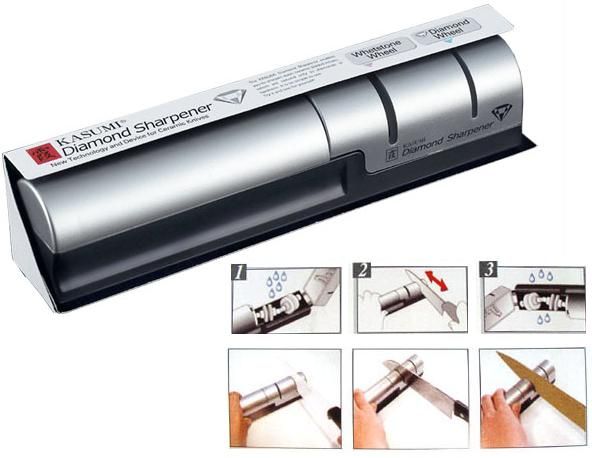
Kasumi Sharpener for ceramics
This Kasumi sharpener with diamonded grinders is the ideal accessory to sharpen ceramics knives or any type of steel knives, even titanized, damascene or with high carbon contents . Easy to use, it allows to sharpen ceramics knives without any difficulty. The Kasumi Diamond sharpener was designed to sharpen also steel thin knives of Japanese style that are sharpened on both sides. It is not fit to sharpen Sashimi or Deba knives that are sharpened on one side and neither some European type knives with large thickness blade. Universal use with water: For ceramics knives, use only diamond wheels. For metal blade knives, use first the pink couple of grinders, then the couple of diamonded grinders to obtain an excellent thin cut. Open the cover and pour water on wheels. Close hermetically the cover and make the blade run through the guide slit. After sharpening, open the cover and clean the inner part with water.
FAQs
What do Kasumi accessories include?
Kasumi accessories include tools dedicated to sharpening, protecting and storing blades correctly. They are not simple add-ons, but elements that directly affect how efficiently and safely a knife can be maintained over time.
What are they really for?
They make knife ownership sustainable in the long term. A good accessory prevents storage mistakes, reduces the risk of edge damage and helps preserve cutting qualities for longer, especially with higher-performing Japanese lines that are more sensitive to improper use.
How should they be chosen correctly?
The choice depends on actual function: sharpeners and stones for edge maintenance, guards and cases for storage, and dedicated supports or organisational solutions for workflow. The correct logic is not to buy accessories generically, but to build a coherent system around the way the knife is really used.
How should they be managed over time?
Accessories also require care: they should be kept clean, used correctly and replaced when they no longer perform their job well. An unsuitable or worn accessory can compromise a blade just as much as incorrect knife use.
What truly distinguishes Kasumi knives within the Japanese knife market?
Kasumi occupies a very interesting position because it strikes a balance between Japanese tradition and real-world accessibility. Its use of VG-10 steel, often combined with Damascus-style layering, allows for strong edge retention and refined cutting performance without necessarily reaching the most extreme hardness levels, which can make a knife more demanding to handle. This makes Kasumi a brand that offers aesthetics, precision and reliability, while remaining more approachable than more elite and demanding lines.
How should the differences between Kasumi series be understood?
Kasumi series differ not only in appearance, but also in their philosophy of use. The Damascus VG-10 line represents the brand’s balance of tradition and visual appeal; VG-10 Pro is geared toward more professional, continuous use; HM Hammered adds a functional benefit in food release; Titanium and Ceramic explore alternative materials; while Tora offers an easier entry point into Japanese knives. Understanding these differences is essential in order to choose based on use, rather than on looks alone.
Who is Kasumi, as a brand, really suited for?
Kasumi is particularly well suited to users who want to enter the world of Japanese knives with serious tools, but without immediately moving into the most extreme premium segment. It is ideal for advanced home cooks, enthusiastic users and also for less demanding professional environments, where a good balance of performance, durability and ease of maintenance matters.
How should someone choose the right Kasumi series in an informed way?
The choice should begin with actual use. Those who cook frequently and want strong performance may prefer VG-10 Pro or HM Hammered; those drawn to aesthetics and tradition may lean toward Damascus VG-10; users seeking greater ease of use may choose Tora; and those with specific needs may consider Ceramic or Titanium. The real question is not which line is objectively best, but which one best matches the way the knife will actually be used.
What is the right maintenance approach for Kasumi knives?
Kasumi knives require the kind of care typically associated with Japanese knives, although the level of tolerance varies depending on the series. VG-10-based lines require more attention in sharpening and everyday use, while series such as Tora or Titanium tend to be slightly more forgiving. In every case, hand washing, immediate drying and the use of suitable cutting boards remain essential.
What distinguishes Japanese knives from Western ones?
Thinner geometries, sharper edge angles and an approach focused on precision and clean cutting.
Santoku or Gyuto: which should you choose?
The santoku is compact and versatile for everyday use; the gyuto is closer to a classic chef’s knife and is ideal for long cuts and sustained work.
Are Japanese knives more delicate?
Yes, they often require more care: they are not suitable for bones, frozen foods or twisting, but offer superior cutting performance when used correctly.
How do you properly sharpen a Japanese knife?
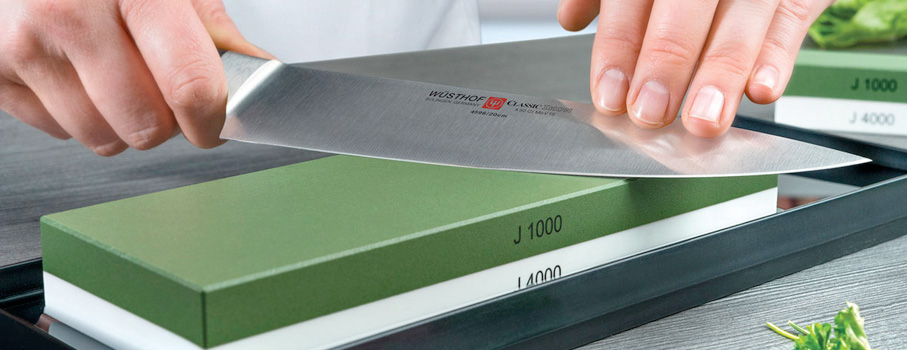
Whetstone sharpening is ideal: a medium grit for maintenance and a finer grit for finishing, adapting the choice to the steel and usage.