WORLDWIDE SHIPPING
Share

Sharpening guide rails

€10.90 €8.93
Availability: In stock
These guide rails are designed to help maintain the correct angle for sharpening knives with a stone.
The angle is 15 degrees.
Two guide for little and big knives.
FAQs
Why is it important to sharpen knives?
A sharp knife is safer and more efficient: it requires less force and delivers precise cuts. A dull blade can slip and increase the risk of accidents.
How often should I sharpen my knives?
It depends on how often you use them and the type of blade. Generally, regular honing with a honing steel is recommended, along with deeper sharpening every few months or when the knife loses effectiveness.
Should I use a honing steel or a sharpener?
A honing steel maintains the edge and prolongs the life of the knife, but it doesn’t actually sharpen. To restore the edge, you need a sharpener (manual, electric, or whetstone). The ideal routine is to use both: the honing steel for daily care, the sharpener for periodic maintenance.
What’s the difference between a smooth, grooved, or ceramic honing steel?
A smooth steel realigns the edge without removing metal. A grooved one has a slightly abrasive action, taking off a small amount of material. A ceramic steel is gentler and suitable even for hard blades like Japanese knives.
How do you correctly use a honing steel?
Hold the steel vertically and draw the blade across both sides at a 15–20° angle using light, steady strokes. Just a few passes are enough to maintain the edge.
Can I sharpen any type of knife?
Almost all types, but be careful with serrated or ceramic blades: they require specific tools or techniques. Always check the manufacturer's guidelines or ask us for advice.
What does the Global Accessories range include?
The Global Accessories range includes complementary tools such as sharpeners, scissors, tongs, bags and storage solutions designed to enhance kitchen performance.
What's in this category?
Accessories and spare parts that complete your sharpening tools: angle guides for stone sharpening, non-slip bases and trays, flattening stones, leather strops for finishing, replacement wheels and inserts for Minosharp and Wüsthof sharpeners, wheels and jigs for the Tormek T-2, and blade-care products such as camellia oil.
What are sharpening stones for?
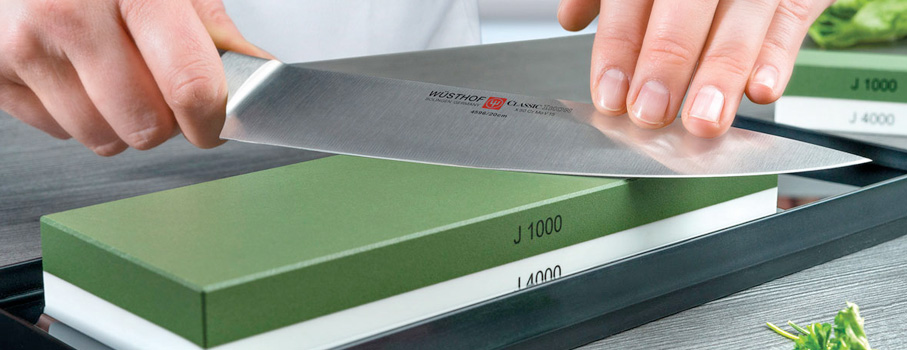
A stone removes steel from the edge and rebuilds it. It gives more control than any other method: your hand sets the angle, not a fixed slot, so it works on Western and Japanese knives and on different thicknesses and profiles. It takes some practice, but it also wastes the least steel, because you only work where the edge needs it.
What are Global accessories used for?
They support food preparation, knife maintenance and safe storage, helping to maintain consistent performance over time.
What are stone sharpening guides for?
They clip onto the spine of the blade and hold it at a steady angle as you move it across the stone. They help most in the first sessions, before your hand has learnt the angle, and on long blades, where it's easy to lose it towards the tip. Check that the guide's angle matches your knife's: a guide keeps the angle steady, but it doesn't choose it for you.
Which grit should I choose?
Grit measures how fine the abrasive is: the higher the number, the finer the stone. Below #400, stones are used to repair small chips or a badly damaged edge; between #800 and #1500 is where the actual sharpening happens; from #3000 upwards, stones refine and polish the edge. For a first stone, a 1000/3000 or 1000/6000 combination stone is the most versatile starting point.
Are Global accessories suitable for professional use?
Yes, they are designed for intensive professional use, featuring durable materials and practical solutions for everyday work.
What is a flattening stone for?
Water stones wear faster in the middle and gradually become hollow. On an uneven surface the blade makes irregular contact and the angle won't stay steady. A flattening stone, with a very coarse grit, brings the surface back to flat. To tell when it's needed, draw a pencil grid on the stone you want to check and rub it on the flattening stone: wherever the marks remain, the surface is low. Keep going until they have all disappeared.
Water stones, oil stones or diamond stones: what's the difference?
Water stones are the most common choice for kitchen knives: they cut quickly and work with a film of water that carries away the residue. Some need soaking before use, others only need wetting on the surface; each stone's product page says which. Oil stones cut more slowly and need the lubricant specified by the manufacturer. Diamond stones remove steel very quickly, stay flat for a long time and also suit very hard steels.
How should I choose the right accessories?
The choice depends on your workflow: sharpeners for edge maintenance, storage solutions for protection and transport, and tools for preparation tasks.
What is a strop and when do I use it?
A strop is a strip of leather, often loaded with a very fine abrasive compound, that you draw the blade along at the end of sharpening. It removes the last traces of burr and polishes the edge. Unlike on a stone, the blade moves spine first, with the edge trailing: the other way round, it would cut into the leather.
What angle should I hold on the stone?
The knife's original one. As a rough guide, many Western knives are sharpened at 15 to 20° per side and many Japanese knives at 10 to 15°, but the exact figure depends on the model and should be checked against the manufacturer's specifications. Holding the angle steady through every stroke matters more than hitting an exact number: a wobbling angle rounds the edge. A clip-on guide on the spine helps in the first sessions.
How do I choose the right spare part for my sharpener?
Wheels, inserts and replacement rods are specific to each model: the part for the Minosharp 220 is a different item from the one for the 440 or the 550. Check the exact name of your sharpener, usually printed on the body or the packaging, and match it to the name in the spare part's title. Replace the abrasive element when the knife no longer regains its edge after the usual number of passes.
How do I know the sharpening has worked?
As you work one side, a thin burr forms on the opposite side. You can feel it by gently drawing a fingertip across the edge, from the spine outwards, never along it. Once the burr runs the full length of the blade, switch sides, then move to finer grits to reduce it. A well-finished edge slices a sheet of paper cleanly, without tearing it.
How do I protect blades between uses?
Carbon steel blades, and to a lesser extent some stainless steels, can stain or rust if left damp. Dry the knife straight after washing and, if it's carbon steel, wipe on a thin film of camellia oil with a cloth. Light surface rust can be removed with a dedicated abrasive rust eraser, without touching the edge.
How do I look after a sharpening stone?
Rinse it after use and let it air-dry away from direct heat; don't put it back in its box while damp. Over time the surface wears hollow in the middle, and on a stone that is no longer flat you can't hold a steady angle: a flattening stone brings it back to flat. It also helps to keep stones of different grits apart, because coarse grit residue scratches the work of a fine stone.
What makes Global knives recognisable?
The seamless stainless steel design and the distinctive dimpled anti-slip handle, combined with thin, well-balanced blades.
Who are Global knives suitable for?
They are ideal for those seeking lightness, manoeuvrability and precision, both in professional kitchens and advanced home use.
What type of maintenance do they require?
Hand washing, immediate drying and regular sharpening are recommended. Avoiding aggressive tools and unsuitable surfaces helps preserve the edge longer.
Which models are considered essential?
A main knife (chef or gyuto), a paring knife and a serrated bread knife cover most kitchen needs.
Chat with us