WORLDWIDE SHIPPING

 IT
 FR

- KNIVES
- JAPANESE KNIVES
- EUROPEAN KNIVES
- PROMOTIONAL AND CUSTOMIZATIONS
- CHEF'S CASES - KNIVES BLOCKS - SETS
- SHARPENING
- PASTRY
- PASTRY UTENSILS
- ACCESSORIES & UTENSILS
- CAKE STANDS AND DISPLAY
- CHOCOLATE
- MARTELLATO PROFESSIONAL
- PAVONI ITALIA
- BRUSHES, SPATULAS AND WHIPS
- SCHNEIDER
- SILICONE
- SILIKOMART PROFESSIONAL
- AIRPLUS
- CHOCADO
- ÉCLAIR
- DECORATIVE ELEMENTS
- FRUITS 3D
- ICE
- MINI DESSERTS - MIGNON
- MODERN SINGLE PORTIONS
- CLASSIC SINGLE PORTIONS AND CAKES
- NATURAE
- 60 X 40 MOLDS
- AIR MAT
- TARTE 4.0
- JELLY MOULDS
- MODERN CAKES
- STORAGE AND DISPLAY I-GLOO AND MACADO'
- MOULDS FOR CHOCOLATES
- CHOCOLATE ACCESSORIES
- SMALL PLATES
- ACCESSORIES
- CRAFT MOULDS
- PASTRY CUTTER
- TRAYS, GRADE, BOWLS, JUGS, BOTTLES
- THERMOMETERS, TIMER AND SCALES
- BAKEWARE, RINGS AND MOULDS
- MOULDS
- PACKAGING AND PASTRY TRAYS
- BAKING MATS & LINERS
- GUITARS - FRAMES
- VALENTINE'S DAY - MOTHER'S DAY
- DECORATING CAKES
- ICE-CREAM SHOP
- PASTRY UTENSILS
- KITCHEN
- WELLNESS KITCHEN
- COOKING UTENSILS
- ELECTRIC KITCHEN UTENSILS
- POTS
- CARVING & DECORATION
- MANDOLINE AND GRATERS
- ETHNIC CUISINE
- CATERING & BUFFET
- COOKING BOOKS

- CLOTHING
- TABLE & BAR
- HOME & FREE TIME
- GIFT IDEAS
- NEWS
- SALES
- SPARE PARTS
- DELUXE
- AFCOLTELLERIE Home
- Blog
- Business


 IT
 FR
- FAQ
- Due Cigni - Coltelli e Accessori
FAQ
Due Cigni - Coltelli e Accessori
FAQs
What truly sets Due Cigni knives and accessories apart?
Due Cigni knives and accessories represent one of the most established expressions of Italian cutlery. Founded in Maniago, internationally recognised as Italy's cutlery capital, the company has been developing tools for professionals and enthusiasts for more than a century, with a focus on build quality, cutting precision and long-term reliability.
Due Cigni's manufacturing philosophy balances traditional craftsmanship with technological innovation. Each knife is designed around its intended use, blade geometry, steel, handle ergonomics and overall balance. The aim is not simply to create a sharp blade, but a tool that feels natural, precise and comfortable even during extended use.
One of Due Cigni's key strengths is the breadth of its range without losing a clear brand identity. The catalogue includes professional and domestic kitchen knives, table knives, specialist tools and accessories designed to complete the user experience. Across the range, Italian design, attention to finishing and practical functionality remain central.
Choosing Due Cigni means choosing a brand that interprets the Italian cutlery tradition through a contemporary approach, creating tools designed to support everyday work with precision, reliability and elegance.
What are the main strengths of the Due Cigni range?
One of the main strengths of the Due Cigni range is its ability to meet very different needs while maintaining a consistent stylistic and quality identity. The catalogue includes chef's knives, Santoku knives, paring knives, bread and meat knives, table knives, specialist tools and a broad selection of accessories for a complete workstation.
Each product family is developed around specific operating requirements. Steel selection, blade hardness, cutting geometry and handle materials are defined according to the intended use, seeking the best balance between precision, edge retention, ease of maintenance and comfort.
Italian design is another distinctive feature. A Due Cigni knife is not conceived only as a technical tool, but as an object intended to be used and appreciated every day. Attention to finishes, proportions and construction details helps combine function with elegance.
This approach allows Due Cigni to serve catering professionals, cooking enthusiasts and users who want knives capable of maintaining high performance over time while also offering strong aesthetic value.
Who are Due Cigni knives and accessories recommended for?
Due Cigni knives are intended for a broad range of users because the different collections address significantly different needs. Chefs, restaurateurs and professional operators can choose models designed for frequent, prolonged use, while cooking enthusiasts can select series with more refined materials, finishes and design.
They are also well suited to anyone wishing to build a complete knife set progressively. Rather than using one knife for every task, a chef's knife can be complemented by specific blades for bread, meat, vegetables or precision work, improving control and reducing effort.
The breadth of the range also makes Due Cigni suitable for users who want to explore quality cutlery without adopting a single cutting tradition: the catalogue combines interpretations of Italian tradition, professional tools and solutions influenced by Japanese knife culture.
What types of food preparation are Due Cigni knives suitable for?
The Due Cigni range can cover virtually all major kitchen preparations when the blade geometry is matched to the ingredient and technique. Chef's knives suit general work with boneless meat, vegetables and herbs; smaller blades provide greater precision for peeling and finishing; serrated knives are suited to bread and foods with a firm crust or surface.
Collections with thinner, more agile geometries are particularly effective when clean cuts are required on vegetables, fish and delicate ingredients. More substantial models favour stability and control in everyday preparation.
Choosing the right knife improves more than precision: it reduces the force required, helps preserve the structure of the ingredient and makes cutting more fluid. The individual Due Cigni series should therefore be assessed in relation to personal cooking techniques rather than selected only by shape or appearance.
How should Due Cigni knives and accessories be maintained?
Maintenance should be adapted to the materials and construction of each Due Cigni series. As a general rule, hand wash the knife with a mild detergent, rinse and dry it immediately, avoiding prolonged contact with water or food residues. Hand washing also helps protect the edge, finishes and handle materials.
Use wooden or suitable synthetic cutting boards and avoid very hard surfaces such as glass, ceramic or stone, which accelerate edge wear. For storage, knife blocks, suitable magnetic racks or individual blade guards help prevent contact with other utensils.
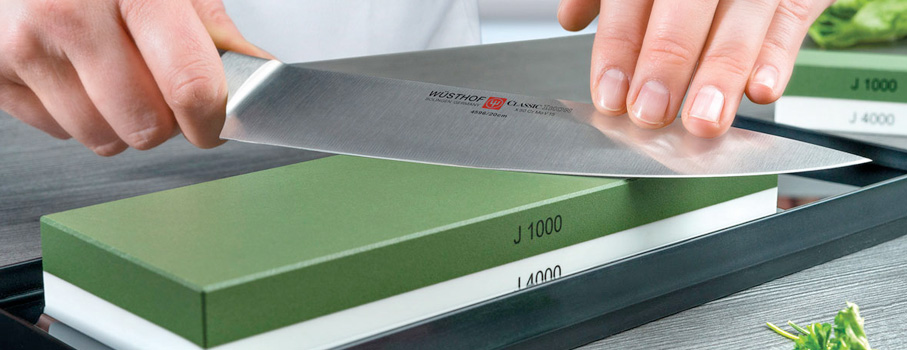
Edge maintenance should be matched to the type of knife: regular honing and actual sharpening are different operations. With thinner or premium blades, it is especially important to use suitable tools and angles and to avoid aggressive procedures that may alter the original geometry.
Categories:
Due Cigni - Coltelli e Accessori