WORLDWIDE SHIPPING

 IT
 FR

- KNIVES
- JAPANESE KNIVES
- EUROPEAN KNIVES
- PROMOTIONAL AND CUSTOMIZATIONS
- CHEF'S CASES - KNIVES BLOCKS - SETS
- SHARPENING
- PASTRY
- PASTRY UTENSILS
- ACCESSORIES & UTENSILS
- CAKE STANDS AND DISPLAY
- CHOCOLATE
- MARTELLATO PROFESSIONAL
- PAVONI ITALIA
- BRUSHES, SPATULAS AND WHIPS
- SCHNEIDER
- SILICONE
- SILIKOMART PROFESSIONAL
- AIRPLUS
- CHOCADO
- ÉCLAIR
- DECORATIVE ELEMENTS
- FRUITS 3D
- ICE
- MINI DESSERTS - MIGNON
- MODERN SINGLE PORTIONS
- CLASSIC SINGLE PORTIONS AND CAKES
- NATURAE
- 60 X 40 MOLDS
- AIR MAT
- TARTE 4.0
- JELLY MOULDS
- MODERN CAKES
- STORAGE AND DISPLAY I-GLOO AND MACADO'
- MOULDS FOR CHOCOLATES
- CHOCOLATE ACCESSORIES
- SMALL PLATES
- ACCESSORIES
- CRAFT MOULDS
- PASTRY CUTTER
- TRAYS, GRADE, BOWLS, JUGS, BOTTLES
- THERMOMETERS, TIMER AND SCALES
- BAKEWARE, RINGS AND MOULDS
- MOULDS
- PACKAGING AND PASTRY TRAYS
- BAKING MATS & LINERS
- GUITARS - FRAMES
- VALENTINE'S DAY - MOTHER'S DAY
- DECORATING CAKES
- ICE-CREAM SHOP
- PASTRY UTENSILS
- KITCHEN
- WELLNESS KITCHEN
- COOKING UTENSILS
- ELECTRIC KITCHEN UTENSILS
- POTS
- CARVING & DECORATION
- MANDOLINE AND GRATERS
- ETHNIC CUISINE
- CATERING & BUFFET
- COOKING BOOKS

- CLOTHING
- TABLE & BAR
- HOME & FREE TIME
- GIFT IDEAS
- NEWS
- SALES
- SPARE PARTS
- DELUXE
- AFCOLTELLERIE Home
- Blog
- Business

 IT
 FR
- FAQ
- Ryda - Serie ST650
FAQ
Ryda - Serie ST650
FAQs
What sets the RYDA ST650 series apart?
The RYDA ST650 series is the result of a long development process focused on ergonomics, steel and cutting geometry. Its identity centres on ST650 powder steel used as the blade core within a 73-layer Damascus construction. In the main models, stated hardness is around 62±1 HRC, with a 15-degree-per-side edge.
The handle is another central element. RYDA states that it drew inspiration from the deep Swedish forests and developed an ergonomic shape able to accommodate different ways of holding a knife. Figured olive wood adds a natural component and gives each handle an individual appearance.
Compared with A-30, ST650 takes a step towards a more sophisticated blade and greater edge retention. It is intended for users who want high performance while considering ergonomics and balance just as important as the steel itself.
Who is the RYDA ST650 series recommended for?
RYDA ST650 is recommended for chefs, professionals and experienced enthusiasts seeking a more advanced blade in terms of hardness and edge retention than a more traditional construction. ST650 powder steel and the 73-layer Damascus structure position the series for users who genuinely work with their knives and want sustained high performance.
Ergonomics nevertheless remains fundamental. The series is interesting for users who alternate between different grips and want a handle that provides blade control without forcing the hand into a single position. Figured olive wood also adds a warmer, more refined character than purely technical handles.
The higher hardness requires appropriate technique: ST650 is not intended for bones, frozen foods or twisting. It is a choice for users who prioritise cutting quality and know how to care for a high-performance blade.
What preparations are RYDA ST650 knives ideal for?
RYDA ST650 knives are particularly suited to preparations where a thin, stable edge can improve precision and smoothness. The chef's knife is designed for vegetables, herbs, boneless meat and general work, while models with different sizes and geometries cover more specific tasks.
The combination of approximately 62±1 HRC hardness and a roughly 15-degree-per-side edge allows the blade to move through food with little resistance when used correctly. This is especially useful in repetitive cutting and preparations where clean surfaces and control matter.
The series should be protected from impacts and unnecessary lateral stress. Using each model for its intended purpose makes the most of ST650 steel and helps preserve sharpness for longer.
How should RYDA ST650 knives be maintained and sharpened?
The hardness and geometry of RYDA ST650 knives require careful maintenance. After each use, hand wash the blade, dry it immediately and store it protected. The olive-wood handle should also be kept away from dishwashers, prolonged immersion and persistent humidity.
Protect the edge by using wooden or suitable synthetic cutting boards. Avoid glass, stone, ceramic, bones and frozen foods, as well as twisting movements that place lateral stress on a hard edge.
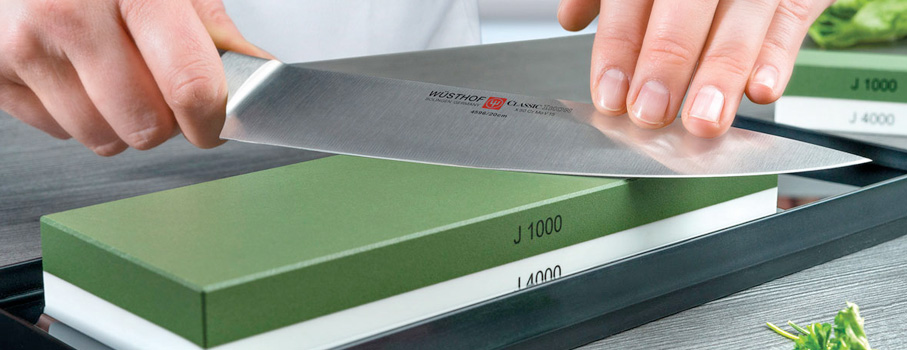
For sharpening, preserve the original angle of approximately 15 degrees per side and use systems suitable for high-hardness powder steel. Acting before the edge becomes completely dull removes less material and preserves the geometry of RYDA ST650 knives for longer.
Categories:
Ryda - Serie ST650