WORLDWIDE SHIPPING

 IT
 FR

- KNIVES
- JAPANESE KNIVES
- EUROPEAN KNIVES
- PROMOTIONAL AND CUSTOMIZATIONS
- CHEF'S CASES - KNIVES BLOCKS - SETS
- SHARPENING
- PASTRY
- PASTRY UTENSILS
- ACCESSORIES & UTENSILS
- CAKE STANDS AND DISPLAY
- CHOCOLATE
- MARTELLATO PROFESSIONAL
- PAVONI ITALIA
- BRUSHES, SPATULAS AND WHIPS
- SCHNEIDER
- SILICONE
- SILIKOMART PROFESSIONAL
- AIRPLUS
- CHOCADO
- ÉCLAIR
- DECORATIVE ELEMENTS
- FRUITS 3D
- ICE
- MINI DESSERTS - MIGNON
- MODERN SINGLE PORTIONS
- CLASSIC SINGLE PORTIONS AND CAKES
- NATURAE
- 60 X 40 MOLDS
- AIR MAT
- TARTE 4.0
- JELLY MOULDS
- MODERN CAKES
- STORAGE AND DISPLAY I-GLOO AND MACADO'
- MOULDS FOR CHOCOLATES
- CHOCOLATE ACCESSORIES
- SMALL PLATES
- ACCESSORIES
- CRAFT MOULDS
- PASTRY CUTTER
- TRAYS, GRADE, BOWLS, JUGS, BOTTLES
- THERMOMETERS, TIMER AND SCALES
- BAKEWARE, RINGS AND MOULDS
- MOULDS
- PACKAGING AND PASTRY TRAYS
- BAKING MATS & LINERS
- GUITARS - FRAMES
- VALENTINE'S DAY - MOTHER'S DAY
- DECORATING CAKES
- ICE-CREAM SHOP
- PASTRY UTENSILS
- KITCHEN
- WELLNESS KITCHEN
- COOKING UTENSILS
- ELECTRIC KITCHEN UTENSILS
- POTS
- CARVING & DECORATION
- MANDOLINE AND GRATERS
- ETHNIC CUISINE
- CATERING & BUFFET
- COOKING BOOKS

- CLOTHING
- TABLE & BAR
- HOME & FREE TIME
- GIFT IDEAS
- NEWS
- SALES
- SPARE PARTS
- DELUXE
- AFCOLTELLERIE Home
- Blog
- Business

 IT
 FR
- FAQ
- Ryda
FAQ
Ryda
FAQs
What sets RYDA knives apart?
RYDA Knives was created from an approach strongly rooted in real kitchen experience. Founder Viktor Ingmarsson worked for many years as a chef and developed the project from the need to improve the ergonomics, balance and comfort of knives used for many consecutive hours. Before the first models were launched, years of testing and refinement were devoted to handles, steels, hardness and edge geometry.
The defining feature of RYDA knives is therefore the relationship between blade and grip. Handles are designed around different ways of holding a knife, particularly the forward or pinch grip used by many chefs. Weight and balance point are not secondary details but integral parts of the design.
A-30, ST650 and A-73 interpret this philosophy with different construction levels and materials. RYDA is therefore aimed at users who look beyond steel hardness or blade aesthetics and want a tool designed around the cutting motion and the relationship between hand, balance and geometry.
What are the main differences between RYDA A-30, ST650 and A-73?
The three RYDA series share a focus on ergonomics but occupy different positions. A-30 is developed for experienced users who appreciate a light, well-balanced construction, with an AUS-10 steel core, hardness around 60 HRC and a stabilised walnut handle. It is technical but relatively straightforward to resharpen and manage in daily work.
ST650 introduces proprietary ST650 powder steel as the core of a 73-layer Damascus construction and uses figured olive-wood handles. In the main models, stated hardness is around 62±1 HRC, with a design focused on high cutting ability and edge retention.
A-73 is the brand's highest-level offering. It also uses ST650, but each knife type is designed more specifically around its function and corresponding balance point. The series celebrates the brand's development and includes the Legacy Chef Knife, winner of a Red Dot Award in 2024.
Who are RYDA knives recommended for?
RYDA knives are particularly suited to chefs, professionals and experienced enthusiasts who pay close attention to ergonomics and balance. The brand philosophy was born from prolonged kitchen use and the search for a grip capable of reducing the strain generated by poorly balanced tools.
A-30 can be interesting for users who already have good technique and want a light, precise knife that is relatively easy to maintain. ST650 is aimed at those seeking a step up in steel quality and edge retention, while A-73 is primarily designed for professionals or enthusiasts seeking the brand's most sophisticated offering.
RYDA is particularly coherent with users of the pinch grip who want to clearly feel the balance point during cutting. As with all high-performance knives, selection should be accompanied by correct technique and maintenance appropriate to blade hardness.
What preparations are RYDA knives ideal for?
RYDA's different geometries cover the main tasks of an advanced kitchen. The chef's knife is the reference for vegetables, herbs, boneless meat and general preparation; Santoku and other more compact profiles can favour control and speed with vegetables and smaller ingredients; carving, utility and paring knives address more specific operations.
RYDA knives are most effective in tasks where balance and precision allow the edge to work without excessive force. The approximately 15-degree-per-side geometry used across several series promotes clean cutting but requires bones, frozen foods and lateral twisting to be avoided.
Choosing the model according to technique is fundamental: RYDA designs the behaviour and balance of different blades around their specific function, an approach especially evident in A-73.
How should RYDA knives be maintained and sharpened?
RYDA knives should be hand washed and dried immediately after use, with particular care for stabilised-wood or olive-wood handles and high-carbon blades. Storage should prevent any contact between the edge and other utensils, using knife blocks, suitable magnetic racks or dedicated guards.
Wooden or appropriate synthetic cutting surfaces are recommended. Glass, ceramic, stone, bones and frozen foods can subject a thin, hard edge to unsuitable stress.
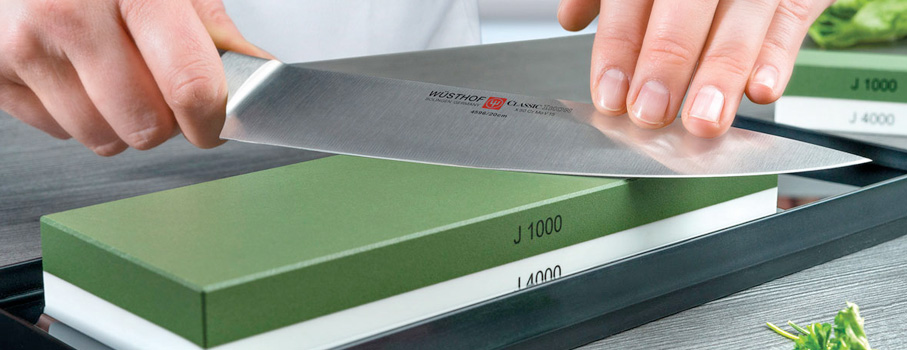
Sharpening should preserve the original geometry: an angle of around 15 degrees per side is common across RYDA series. A-30, at around 60 HRC, is also designed for relatively accessible resharpening; the harder ST650 and A-73 require even greater precision. Controlled, minimally invasive maintenance preserves performance and blade profile for longer.
Categories:
Ryda