WORLDWIDE SHIPPING

 IT
 FR

- KNIVES
- JAPANESE KNIVES
- EUROPEAN KNIVES
- PROMOTIONAL AND CUSTOMIZATIONS
- CHEF'S CASES - KNIVES BLOCKS - SETS
- SHARPENING
- PASTRY
- PASTRY UTENSILS
- ACCESSORIES & UTENSILS
- CAKE STANDS AND DISPLAY
- CHOCOLATE
- MARTELLATO PROFESSIONAL
- PAVONI ITALIA
- BRUSHES, SPATULAS AND WHIPS
- SCHNEIDER
- SILICONE
- SILIKOMART PROFESSIONAL
- AIRPLUS
- CHOCADO
- ÉCLAIR
- DECORATIVE ELEMENTS
- FRUITS 3D
- ICE
- MINI DESSERTS - MIGNON
- MODERN SINGLE PORTIONS
- CLASSIC SINGLE PORTIONS AND CAKES
- NATURAE
- 60 X 40 MOLDS
- AIR MAT
- TARTE 4.0
- JELLY MOULDS
- MODERN CAKES
- STORAGE AND DISPLAY I-GLOO AND MACADO'
- MOULDS FOR CHOCOLATES
- CHOCOLATE ACCESSORIES
- SMALL PLATES
- ACCESSORIES
- CRAFT MOULDS
- PASTRY CUTTER
- TRAYS, GRADE, BOWLS, JUGS, BOTTLES
- THERMOMETERS, TIMER AND SCALES
- BAKEWARE, RINGS AND MOULDS
- MOULDS
- PACKAGING AND PASTRY TRAYS
- BAKING MATS & LINERS
- GUITARS - FRAMES
- VALENTINE'S DAY - MOTHER'S DAY
- DECORATING CAKES
- ICE-CREAM SHOP
- PASTRY UTENSILS
- KITCHEN
- WELLNESS KITCHEN
- COOKING UTENSILS
- ELECTRIC KITCHEN UTENSILS
- POTS
- CARVING & DECORATION
- MANDOLINE AND GRATERS
- ETHNIC CUISINE
- CATERING & BUFFET
- COOKING BOOKS

- CLOTHING
- TABLE & BAR
- HOME & FREE TIME
- GIFT IDEAS
- NEWS
- SALES
- SPARE PARTS
- DELUXE
- AFCOLTELLERIE Home
- Blog
- Business


 IT
 FR
- FAQ
- Ryda - Serie A-73
FAQ
Ryda - Serie A-73
FAQs
What makes RYDA A-73 the brand's most advanced series?
RYDA presents A-73 as its highest-level collection, with each knife designed specifically around the function it must perform. This is especially evident in the balance: the chef's knife uses a more forward balance point to support a high pinch grip, while the slicing knife shifts the balance more towards the handle for a steadier grip during cutting.
The blade uses a 73-layer San Mai Damascus construction with an ST650 powder-steel core. In the main models hardness reaches approximately 63 HRC, while the handle is made from figured French olive wood. RYDA also states results above 840 in CATRA testing with its sharpening geometry.
A-73 is therefore a synthesis of materials, ergonomics and function-specific design. The series also celebrates ten years of RYDA's development and includes the Legacy Chef Knife, winner of a Red Dot Award in 2024.
Who is the RYDA A-73 series recommended for?
RYDA A-73 is designed primarily for professional chefs and experienced users who want to move to a higher-level knife set, but it can also suit those starting a professional path and wishing to invest from the outset in knives designed to last for many years. The key is the user's ability to appreciate differences in balance and geometry from one blade to another.
A-73 is particularly interesting for users of the pinch grip who consider the balance point an essential part of the cutting experience. Its model-specific design avoids applying the same weight distribution to knives intended for different functions.
The high hardness and thin edge require correct technique. A-73 is not intended for indiscriminate work: it is designed for users seeking precision, control and edge retention who know how to protect a premium blade from impacts, twisting and unsuitable surfaces.
What performance does ST650 steel deliver in the RYDA A-73 series?
In RYDA A-73, ST650 powder steel forms the functional core of a 73-layer San Mai Damascus blade. In the chef's, utility and paring models, stated hardness reaches approximately 63 HRC, a value intended to maintain a highly effective edge during prolonged use. The geometry is sharpened to around 15 degrees per side.
RYDA associates this construction with a CATRA test result above 840, a test used to assess cutting performance and edge durability. This helps explain the positioning of the series: A-73 is not focused only on Damascus aesthetics, but on a combination of steel, treatment and geometry aimed at high cutting performance.
Higher hardness also brings greater responsibility in use. Edge retention is best exploited with controlled cutting and suitable surfaces, while impacts, bones and twisting should be avoided.
How should RYDA A-73 knives be maintained?
A premium series such as RYDA A-73 requires maintenance consistent with blade hardness and handle materials. The knife should be hand washed immediately after use, dried thoroughly and stored so the edge cannot contact other utensils. The figured olive-wood handle should be protected from dishwashers and prolonged immersion.
Wooden or suitable synthetic cutting surfaces are recommended. Glass, ceramic, stone, bones and frozen foods can compromise a thin, hard edge. Lateral movements and using the blade as a lever should also be avoided.
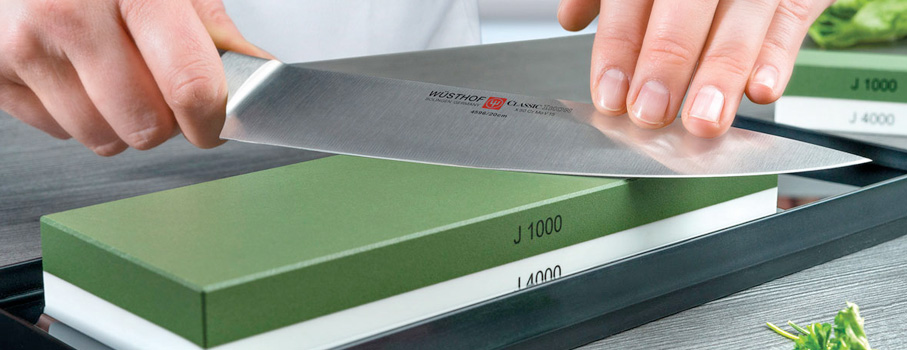
When resharpening is required, maintain the original geometry of approximately 15 degrees per side using stones or systems suitable for very hard powder steels. Precise preventive maintenance helps A-73 retain its combination of sharpness, balance and aesthetic quality.
Categories:
Ryda - Serie A-73