WORLDWIDE SHIPPING

 IT
 FR

- KNIVES
- JAPANESE KNIVES
- EUROPEAN KNIVES
- PROMOTIONAL AND CUSTOMIZATIONS
- CHEF'S CASES - KNIVES BLOCKS - SETS
- SHARPENING
- PASTRY
- PASTRY UTENSILS
- ACCESSORIES & UTENSILS
- CAKE STANDS AND DISPLAY
- CHOCOLATE
- MARTELLATO PROFESSIONAL
- PAVONI ITALIA
- BRUSHES, SPATULAS AND WHIPS
- SCHNEIDER
- SILICONE
- SILIKOMART PROFESSIONAL
- AIRPLUS
- CHOCADO
- ÉCLAIR
- DECORATIVE ELEMENTS
- FRUITS 3D
- ICE
- MINI DESSERTS - MIGNON
- MODERN SINGLE PORTIONS
- CLASSIC SINGLE PORTIONS AND CAKES
- NATURAE
- 60 X 40 MOLDS
- AIR MAT
- TARTE 4.0
- JELLY MOULDS
- MODERN CAKES
- STORAGE AND DISPLAY I-GLOO AND MACADO'
- MOULDS FOR CHOCOLATES
- CHOCOLATE ACCESSORIES
- SMALL PLATES
- ACCESSORIES
- CRAFT MOULDS
- PASTRY CUTTER
- TRAYS, GRADE, BOWLS, JUGS, BOTTLES
- THERMOMETERS, TIMER AND SCALES
- BAKEWARE, RINGS AND MOULDS
- MOULDS
- PACKAGING AND PASTRY TRAYS
- BAKING MATS & LINERS
- GUITARS - FRAMES
- VALENTINE'S DAY - MOTHER'S DAY
- DECORATING CAKES
- ICE-CREAM SHOP
- PASTRY UTENSILS
- KITCHEN
- WELLNESS KITCHEN
- COOKING UTENSILS
- ELECTRIC KITCHEN UTENSILS
- POTS
- CARVING & DECORATION
- MANDOLINE AND GRATERS
- ETHNIC CUISINE
- CATERING & BUFFET
- COOKING BOOKS

- CLOTHING
- TABLE & BAR
- HOME & FREE TIME
- GIFT IDEAS
- NEWS
- SALES
- SPARE PARTS
- DELUXE
- AFCOLTELLERIE Home
- Blog
- Business

 IT
 FR
- FAQ
- Pietre per affilare
FAQ
Pietre per affilare
FAQs
What are sharpening stones for?
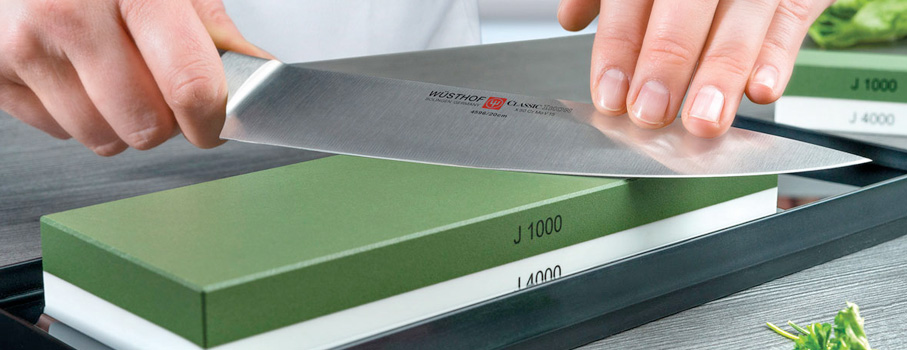
A stone removes steel from the edge and rebuilds it. It gives more control than any other method: your hand sets the angle, not a fixed slot, so it works on Western and Japanese knives and on different thicknesses and profiles. It takes some practice, but it also wastes the least steel, because you only work where the edge needs it.
Which grit should I choose?
Grit measures how fine the abrasive is: the higher the number, the finer the stone. Below #400, stones are used to repair small chips or a badly damaged edge; between #800 and #1500 is where the actual sharpening happens; from #3000 upwards, stones refine and polish the edge. For a first stone, a 1000/3000 or 1000/6000 combination stone is the most versatile starting point.
Water stones, oil stones or diamond stones: what's the difference?
Water stones are the most common choice for kitchen knives: they cut quickly and work with a film of water that carries away the residue. Some need soaking before use, others only need wetting on the surface; each stone's product page says which. Oil stones cut more slowly and need the lubricant specified by the manufacturer. Diamond stones remove steel very quickly, stay flat for a long time and also suit very hard steels.
What angle should I hold on the stone?
The knife's original one. As a rough guide, many Western knives are sharpened at 15 to 20° per side and many Japanese knives at 10 to 15°, but the exact figure depends on the model and should be checked against the manufacturer's specifications. Holding the angle steady through every stroke matters more than hitting an exact number: a wobbling angle rounds the edge. A clip-on guide on the spine helps in the first sessions.
How do I know the sharpening has worked?
As you work one side, a thin burr forms on the opposite side. You can feel it by gently drawing a fingertip across the edge, from the spine outwards, never along it. Once the burr runs the full length of the blade, switch sides, then move to finer grits to reduce it. A well-finished edge slices a sheet of paper cleanly, without tearing it.
How do I look after a sharpening stone?
Rinse it after use and let it air-dry away from direct heat; don't put it back in its box while damp. Over time the surface wears hollow in the middle, and on a stone that is no longer flat you can't hold a steady angle: a flattening stone brings it back to flat. It also helps to keep stones of different grits apart, because coarse grit residue scratches the work of a fine stone.
Categories:
Pietre per affilare